
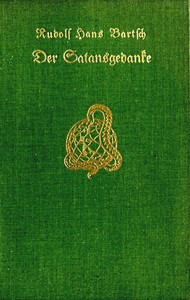
Der Satansgedanke by Rudolf Hans Bartsch
Set in the elegant, anxious Vienna of the early 20th century, Der Satansgedanke follows a circle of young intellectuals—writers, painters, musicians—who feel trapped by the rigid rules of their society. They gather around a magnetic but unstable figure who preaches a radical new philosophy. He argues that to achieve the highest forms of art and human freedom, they must break every taboo, even the moral ones. What starts as rebellious talk in smoky cafes slowly becomes a chilling reality.
The Story
The plot centers on this group's descent. Their leader's 'satanic idea' isn't about worshiping the devil, but about believing that evil is a necessary force for creation. He pushes his followers to explore their darkest impulses in the name of art and progress. We see this through the eyes of a younger member, both fascinated and horrified. As the group's experiments become more extreme, friendships fracture, sanity is tested, and the line between artistic breakthrough and moral collapse completely blurs. All of this happens as the storm clouds of the Great War gather on the horizon, mirroring the personal destruction unfolding within the group.
Why You Should Read It
Bartsch writes with a psychologist's eye. He doesn't give us cartoon villains, but real, confused people seduced by a dangerous idea. The tension comes from watching smart people make terrible choices, believing they're on the path to enlightenment. The setting is a character itself—all that Viennese glamour hiding a deep sickness. It made me think about how easily any of us, in our search for meaning or change, can be led down a dark path by a persuasive voice. It's a warning wrapped in a very compelling period drama.
Final Verdict
This book is perfect for readers who love historical fiction with a psychological punch. If you enjoyed the moody atmosphere of The Picture of Dorian Gray or the group dynamics of The Secret History, you'll find a lot to like here. It's not a fast-paced action book; it's a slow, creeping examination of corruption. You need to be patient with its older style, but the payoff is a story that feels disturbingly relevant. It’s for anyone who's ever wondered how entire societies can lose their way, one compromised principle at a time.
This title is part of the public domain archive. Preserving history for future generations.
Joseph Anderson
9 months agoIt took me a while to process the complex ideas here, but the footnotes provide extra depth for those who want to dig deeper. I am looking forward to the author's next publication.
Deborah Ramirez
2 years agoAfter finishing this book, it creates a vivid world that you simply do not want to leave. Truly inspiring.
Ava Jackson
2 years agoI didn't expect much, but the depth of research presented here is truly commendable. I would gladly recommend this title.
Joseph Martin
1 year agoFast paced, good book.


James Johnson
3 months agoI've been looking for a reliable source on this topic, and the evidence-based approach makes it a very credible source of information. I'll be recommending this to my students and colleagues alike.