
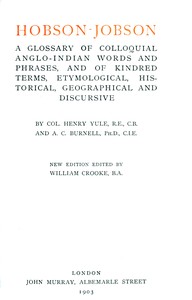
Hobson-Jobson by Sir Henry Yule and A. C. Burnell
Let's get one thing straight: Hobson-Jobson is not a book you read from cover to cover. It's a reference work, a historical dictionary published in 1886. But calling it just a dictionary is like calling the ocean a puddle. Compiled by Sir Henry Yule and Arthur Coke Burnell, it's an A-to-Z (well, really A-to-Zeytun) guide to the words and phrases of Anglo-India—the unique slang that developed as the British lived, worked, and often bungled their way through the Indian subcontinent.
The Story
There's no plot in the traditional sense. Instead, the 'story' is the journey of language itself. The book's title is its own best example: 'Hobson-Jobson' is a corrupted English version of the Arabic cries 'Yā Ḥasan! Yā Ḥusayn!' heard during Muharram processions. The authors collected thousands of such terms—from military jargon and food names to legal titles and insults. For each entry, they didn't just give a dry definition. They dug up quotes from old travelogues, letters, and histories, showing how the word was used over centuries. You follow a word like 'cash' from its Tamil origins, through Portuguese traders, and into English ledgers. It's a biography of vocabulary, with each entry a snapshot of cultural collision.
Why You Should Read It
I love this book because it turns history into gossip. You're not reading about treaties and battles; you're seeing how soldiers, merchants, and families actually talked. You learn that 'punch' the drink comes from the Hindi word for 'five' (for its ingredients), that 'dungarees' are named after a Mumbai neighborhood, and that 'curry' is a British simplification of a dozen different Indian dishes. The authors' footnotes are full of wit, sarcasm, and fascinating tangents. It feels like you're rummaging through the cluttered, brilliant minds of two incredibly curious men. It makes you realize that English is a magpie language, built by picking up shiny words from everywhere it went.
Final Verdict
This is the perfect book for word nerds, history lovers who prefer stories to statistics, and anyone with a soft spot for the weird and wonderful. Dip into it for five minutes and you'll find three amazing facts to share at a party. It's a browser's paradise. While the original Victorian prose can be dense, modern editions often have helpful introductions. If you've ever wondered why English is such a glorious, messy language, Hobson-Jobson has about a thousand answers, each more surprising than the last.
This book is widely considered to be in the public domain. Knowledge should be free and accessible.
Anthony Smith
10 months agoI came across this while browsing and the atmosphere created is totally immersive. One of the best books I've read this year.
Betty Wilson
3 months agoSolid story.
Jessica Sanchez
1 year agoI didn't expect much, but the arguments are well-supported by credible references. I couldn't put it down.
Robert Harris
3 months agoThis book was worth my time since the flow of the text seems very fluid. I learned so much from this.

Margaret Johnson
1 year agoFive stars!