
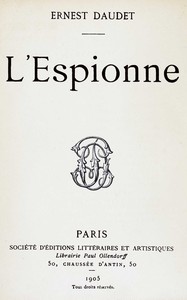
L'espionne by Ernest Daudet
Ernest Daudet's L'espionne pulls you into the treacherous, elegant world of 19th-century French politics, where the most dangerous weapons are secrets and the most valuable currency is trust.
The Story
The novel centers on a woman—her name often guarded as closely as her missions—who operates as a spy for France. We follow her not through bloody battlefields, but through salons and ballrooms, places where the fate of nations is decided over champagne and clever conversation. Her life is a balancing act: maintaining her social standing while extracting crucial information from those in power. The plot thickens as her dual life becomes increasingly precarious. A single misstep, a moment of misplaced confidence, or a lover's suspicion could unravel everything. The suspense builds from the constant, quiet threat of exposure, making even a friendly glance feel like a potential threat.
Why You Should Read It
What grabbed me wasn't just the spying, but the human story at its core. Daudet is brilliant at showing the loneliness and emotional toll of this work. His spy isn't a cold machine; she's a person who has to sacrifice real connections for her duty. You feel the weight of every lie she tells and the isolation of a life lived behind a mask. The book also offers a fascinating, ground-level view of history. You see how political power really worked in those days—through personal influence, family ties, and whispered alliances. It feels authentic and immersive.
Final Verdict
This book is perfect for readers who love historical fiction with strong, complex characters and psychological tension. If you enjoy stories about hidden identities, moral ambiguity, and the high personal cost of patriotism, you'll be hooked. It’s not a fast-paced action novel; it’s a thoughtful, character-driven exploration of loyalty and sacrifice. Think of it as a superb period drama in book form, one that proves the quietest stories can often be the most gripping.
This work has been identified as being free of known copyright restrictions. Knowledge should be free and accessible.
Sarah Thompson
10 months agoRight from the opening paragraph, the clarity of the writing makes even the most dense sections readable. An excellent example of how quality digital books should be formatted.
Donald Rodriguez
2 years agoIt took me a while to process the complex ideas here, but the argument presented in the middle section is particularly compelling. I'll be citing this in my upcoming project.
George Lopez
1 year agoI appreciate the objective tone and the evidence-based approach.
Patricia Lopez
8 months agoThe balance between academic rigor and readability is perfect.


Barbara Lopez
1 year agoI started reading this with a critical mind, the logic behind each conclusion is easy to follow and verify. A rare gem in a sea of mediocre content.