
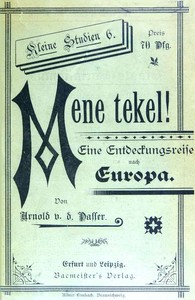
Mene tekel! Eine Entdeckungsreise nach Europa by Arnold von der Passer
Published in 1909, Arnold von der Passer's Mene tekel! is a strange and compelling hybrid. It's part travel narrative, part social critique, and part eerie prophecy, all wrapped in a novel's clothing.
The Story
The book follows an unnamed German narrator on a grand tour of early 20th-century Europe. He visits the major capitals and cultural centers, from London and Paris to Vienna and Berlin. On the surface, he describes the achievements of the age: impressive industry, sprawling empires, and dazzling scientific advances. But his eye is relentlessly critical. He doesn't just see the pomp; he sees the poverty festering in the shadows of grand boulevards. He hears not just nationalist pride, but the dangerous, grinding gears of militarism and ethnic tension. The 'voyage of discovery' isn't about finding beauty—it's about uncovering a deep-seated sickness he believes is rotting Europe's core. The title, a biblical reference meaning 'numbered, weighed, and found wanting,' hangs over every chapter like a verdict he's waiting for the world to acknowledge.
Why You Should Read It
What grabbed me wasn't the plot, which is thin, but the overwhelming mood of dread. Knowing the cataclysm of 1914 was just five years away makes every observation feel charged. When the narrator describes the frantic pace of arms manufacturing or the shallow, pleasure-obsessed society of pre-war capitals, it's impossible not to get chills. Von der Passer wasn't a historian predicting the future; he was a sensitive observer screaming into the wind about the present. His narrator is often insufferably pessimistic and superior, which actually makes him more interesting—he's not a hero, but a Cassandra. You read it for that unique, uncomfortable perspective of being inside the 'before times,' seeing the cracks that everyone else is papering over with flags and champagne.
Final Verdict
This isn't a light read or a page-turner in the traditional sense. It's a slow, thoughtful, and profoundly sobering experience. Perfect for history buffs who want to feel the intellectual climate of pre-WWI Europe, or for readers who love primary sources that crackle with contemporary anxiety. If you enjoyed the ominous atmosphere of Stefan Zweig's The World of Yesterday or the critical travel writing of someone like Rebecca West, you'll find a fascinating (and sadly overlooked) precursor here. Be prepared for dense prose and a relentlessly grim outlook, but if you stick with it, you'll be rewarded with a book that feels like it's whispering secrets from the edge of a volcano.
The copyright for this book has expired, making it public property. Enjoy reading and sharing without restrictions.
Charles Robinson
1 year agoAfter finishing this book, the pacing is just right, keeping you engaged. Worth every second.
Nancy Gonzalez
1 year agoBased on the summary, I decided to read it and the plot twists are genuinely surprising. This story will stay with me.
Noah Wilson
1 year agoThe fonts used are very comfortable for long reading sessions.
Anthony White
1 year agoCompatible with my e-reader, thanks.



Margaret Rodriguez
1 year agoFast paced, good book.