
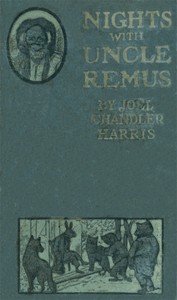
Nights With Uncle Remus: Myths and Legends of the Old Plantation by Harris
Picture this: the end of a long day on a Southern plantation. A curious little boy sneaks away to the cabin of Uncle Remus, an elderly Black man. There, by the hearth, night after night, Remus tells him stories. That's the simple frame for this book. It's not one continuous plot, but a series of visits where we hear the legendary adventures of the animals in the Briar Patch.
The Story
The real 'story' is in the tales themselves. We follow Brer Rabbit, who is small and seemingly helpless, as he constantly tangles with bigger, tougher animals like Brer Fox and Brer Wolf. They're always trying to catch him, eat him, or teach him a lesson. But Brer Rabbit's power isn't in his muscles—it's in his mind. He talks his way out of traps, reverses situations on his enemies, and turns their strength against them. From the famous 'Tar-Baby' story to wild races and clever deceptions, each chapter is a short, self-contained battle of wits where the underdog usually comes out on top, much to the delight of the listening boy (and the reader).
Why You Should Read It
This book is a direct line to a rich tradition of American folklore. Yes, it's funny. Brer Rabbit's schemes are hilarious. But listen closer, and you'll hear something powerful. These stories were born from a culture of people who had to be clever to survive. They're about using intelligence when you have no other power. That theme is timeless. I also love the relationship between Uncle Remus and the boy. It's complex—it exists within the harsh reality of its time—but in these moments of storytelling, there's a genuine connection, a sharing of wisdom and laughter that feels very human.
Final Verdict
This is a must-read for anyone interested in the roots of American stories, folklore, or African-American cultural history. It's also perfect if you just love a good, smart trickster tale. A fair warning: the book is written in a heavy 19th-century Southern dialect, which can be challenging at first. Push through it, read it aloud if you can, and let the rhythm pull you in. It's not a modern book, so approach it as a historical document and a collection of brilliant, enduring fables. You'll come for the rabbit and the fox, but you'll stay for the sharp, surprising wisdom.
Legal analysis indicates this work is in the public domain. You are welcome to share this with anyone.
Mark Smith
11 months agoMy professor recommended this, and I see why.
Barbara Lewis
1 year agoI came across this while browsing and it challenges the reader's perspective in an intellectual way. Worth every second.
Richard Hernandez
1 year agoAfter hearing about this author multiple times, it challenges the reader's perspective in an intellectual way. Exceeded all my expectations.
Richard Allen
1 year agoThis is one of those stories where the narrative structure is incredibly compelling. I learned so much from this.




George Moore
11 months agoI started reading out of curiosity and the narrative structure is incredibly compelling. I will read more from this author.