About 349 minutes
Editorials from the Hearst Newspapers — A Closer Reading
Adventure Picaresque Fiction
80,050 recorded words. 5 minutes difference from this book's estimate.
View Gutenberg source #742
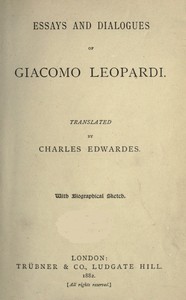
Essays and Dialogues — Text and Context can be approached with a clearer sense of reading commitment from its source measurements: 79,009 words, 5 hr 44 min estimated reading time, and 9 detected text sections.
The text analysis averages about 21.7 words per sentence, while the detected sections provide another way to judge how the source is divided.
Project Gutenberg metadata also associates the work with “Essays,” connecting these edition facts with the source record’s subject description.
Explore this collection
These alternatives are selected using recorded categories and estimated reading time.
About 349 minutes
Adventure Picaresque Fiction
80,050 recorded words. 5 minutes difference from this book's estimate.
View Gutenberg source #742About 364 minutes
Adventure Picaresque Fiction
83,600 recorded words. 20 minutes difference from this book's estimate.
View Gutenberg source #19244About 365 minutes
Adventure Picaresque Fiction
83,731 recorded words. 21 minutes difference from this book's estimate.
View Gutenberg source #25854Search stored excerpts and compare books → Choose by your preferences →
Choices use stored catalog measurements. Estimates vary with reading speed. A shared category is a catalog label, not a claim that two books have the same argument or literary quality.
Search reads excerpt text stored with this catalog and links to its associated Gutenberg record. The connection is stored in the site database; this tool does not recheck that every excerpt is word-for-word identical to that external record. Excerpt search does not cover every chapter and does not verify historical publication dates.
Catalog snapshot checked: 2026-09-25. Coverage: 96 public books, 96 available source excerpts.
Read the complete public-domain text at its original source.
Read on Project GutenbergLeopardi’s prose in this collection moves between two distinct registers: the tightly reasoned argument of the philosophical essay and the ironic, often comic exchange of the dialogue. In the biographical sketch, the translator describes Leopardi’s reputation as “triple-faceted”—philology, poetry, philosophy—and the writings themselves bear this out. The opening “History of the Human Race” sets a mythic tone, while later pieces such as “Dialogue Between Fashion and Death” deploy personification and wit. The excerpts show a writer who can shift from abstract meditation on the difficulty of gaining praise for philosophical works to the brisk, sardonic back-and-forth of a goblin and a gnome. This variety in voice and pace is the collection’s most distinctive feature.
The essays often build arguments through patient, cumulative reasoning, as in the passage where Leopardi discusses how new truths are received: “no truth contrary to current opinion, even though demonstrable with almost geometrical certitude, can ever, unless capable of material proof, be suddenly established.” The sentences are long, qualified, and deliberate. By contrast, the dialogues snap with brevity. In “Dialogue Between a Goblin and a Gnome,” the exchange is rapid, each rejoinder undercutting the previous speaker’s position. This alternation between sustained exposition and staccato repartee gives the collection a rhythm that keeps the reader alert. The philosophical essays demand patience; the dialogues reward it with punchlines.
A thread running through several pieces is the unreliability of human opinion. In the excerpt on philosophical writings, Leopardi notes that readers often attack works “because of the incapacity of the readers, and their inability to comprehend the certainty of the principles.” He extends this skepticism to the reception of new ideas: “Men accustom themselves to belief, as to everything else; indeed they generally believe from habit, and not from any sentiment of conviction.” This distrust of collective judgment appears again in the dialogue between an almanac seller and a passer-by, where common assumptions about the new year are gently mocked. Leopardi’s narrators and speakers consistently question whether praise, fame, or understanding can ever be justly awarded.
Leopardi populates his dialogues with an unusual range of speakers: Hercules and Atlas, a goblin and a gnome, Nature and an Icelander, an almanac seller and a passer-by. This mix of the grandiose and the mundane allows him to shift tone without warning. The “Dialogue Between Hercules and Atlas” treats the burden of the cosmos as a comic inconvenience; the “Dialogue Between an Almanac Seller and a Passer-by” reduces existential anxiety to a street-corner transaction. The effect is to deflate philosophical pretension while still pursuing serious questions. The reader never knows whether the next speaker will be a god or a tradesman, and this unpredictability keeps the prose lively even when the subject is bleak.
Because the excerpts offer only fragments, the full arc of Leopardi’s argumentative strategy remains partly hidden. Readers should attend to how each piece establishes its own pace—whether by slow, layered reasoning or by rapid, ironic exchange. The translator’s biographical sketch suggests a writer of wide learning, and the table of contents promises further variety, including dialogues with Columbus and Copernicus. The best approach is to read the dialogues aloud, letting the shifts in voice reveal the wit beneath the melancholy.
That rainy afternoon, Leopardi’s Fashion and Death bickered past my window’s drumming, their irony settling like damp in the bones. I closed the book, thinking of all the letters we never write. Somehow, my hand drifted to Miss Eden's Letters — A Reader’s Guide, finding the same amused, resigned warmth, but spoken in a voice less doomed.
Create a short personal record of your experience with this book.