
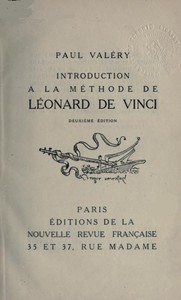
Introduction à la méthode de Léonard de Vinci by Paul Valéry
Let's be clear from the start: if you're hoping for a straightforward story about Leonardo da Vinci's life, you'll be disappointed. Paul Valéry's Introduction à la méthode de Léonard de Vinci is something else entirely. It's a mental adventure. Valéry uses the figure of Leonardo not as a historical subject, but as a perfect case study—an 'ideal creature' of the intellect. The 'plot' is the journey of Valéry's own thoughts as he puzzles over how one man could seamlessly move from painting the world's most famous portrait to sketching flying machines and studying the flow of water.
The Story
There's no narrative in the traditional sense. Think of it as a series of connected reflections. Valéry starts by marveling at the sheer range of Leonardo's notebooks. He sees in them not just random sketches, but evidence of a unified way of seeing the world. For Valéry, Leonardo's 'method' was a kind of universal thinking, where the eye of the artist and the mind of the scientist were the same tool. The 'story' is Valéry trying to reconstruct that mental process, to imagine what it must have been like inside that head. He argues that creation isn't about random inspiration, but about a disciplined, almost mathematical, curiosity applied to everything.
Why You Should Read It
I loved this book because it made me feel smarter just by reading it. It’s not easy—Valéry’s prose is dense and poetic—but the ideas are exhilarating. He’s less interested in the paintings themselves than in the engine that produced them. The central theme is the power of a connected mind. In our age of hyper-specialization, Valéry’s Leonardo is a thrilling reminder of what’s possible when you refuse to put boundaries between art and science, beauty and function. It’s a short book that you’ll read slowly, because every few pages you’ll have to stop and stare at the wall, thinking about your own capacity for wonder.
Final Verdict
This is a book for the intellectually curious, not the casually interested. It's perfect for anyone who’s ever fallen down a Wikipedia rabbit hole just for the joy of learning, or for creative people feeling stuck in their own niche. If you enjoy writers who make you work for the insight—think of it as a philosophical workout—you’ll find Valéry’s obsession contagious. It’s a brilliant, challenging, and ultimately inspiring look at the architecture of genius, from one great mind trying to understand another.
This title is part of the public domain archive. Access is open to everyone around the world.
Ava Wright
1 year agoThanks for the recommendation.
Sandra King
1 year agoAfter finishing this book, the character development leaves a lasting impact. I couldn't put it down.
Steven Martin
1 year agoVery helpful, thanks.
William Ramirez
7 months agoBased on the summary, I decided to read it and it challenges the reader's perspective in an intellectual way. I learned so much from this.


Kenneth Miller
5 months agoCitation worthy content.