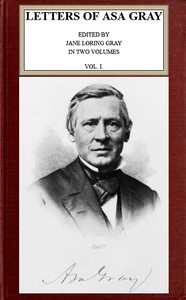
The editor's note explains that these letters were chosen to show Gray's life and occupation in his own words, with many given as fragments. The volume opens with a brief autobiographical sketch, covering his ancestry and early years, before launching into correspondence from his first European journey in 1838–1839. This structure immediately signals that the collection prioritizes personal voice over scientific completeness.
Gray's letters from Vienna in May 1839 illustrate his characteristic blend of scientific duty and human detail. He describes changing dried plants, caring for a sick companion, and declining an opera invitation because he would 'sleep through the finest music.' Such passages ground the scientific traveler in everyday realities.
The Autobiographical Fragment as a Lens
The volume begins not with a letter but with a brief autobiography Gray started but never finished. This fragment, placed at the start by editor Jane Loring Gray, traces his lineage from a Scotch-Irish colony in Worcester, Massachusetts, through moves to Templeton, Grafton, and Oneida County. The detail of family migrations—his grandfather removing to Vermont in 1787, then to New York in 1794—sets a pattern of movement that the letters will echo.
Readers should note that this opening is not a full life story but a sketch of early conditions. The editor explicitly states Gray 'went no further than to give a brief sketch of his early life.' This incompleteness makes the fragment a suggestive preface rather than a definitive biography, inviting readers to watch for how the letters fill in the later years.
Scientific Routine Amid European Travel
Gray's letters from Vienna in 1839 show a daily rhythm of herbarium visits, plant-drying, and correspondence. He writes of going 'early this morning to the Imperial Cabinet' and staying until closing, then exploring the city until sunset. This pattern—museum work by day, sightseeing by evening—recurs throughout the European journey.
The letters also reveal the practical challenges of travel. Gray's companion Philip falls ill with intermittent fever, and Gray notes the difficulty of being 'sick in a strange land.' He contrasts his own robust health with Philip's distress, a reminder that scientific travel was physically demanding. These details, though brief, give texture to the professional narrative.
Descriptive Precision in Unfamiliar Landscapes
Gray's account of the Grotto of Adelsberg demonstrates his descriptive eye. He calls it 'without doubt the most wonderful thing of its kind in the world,' then carefully sets the scene: a village 'perched under a steep conical hill,' a circular plain 'shut out from the rest of the world,' and a river that 'dives into the solid rock.' The simile comparing the stream to Fishkill Creek grounds the exotic in the familiar.
This passage, though incomplete in the excerpt, shows Gray's ability to convey scale and atmosphere. He notes the difficulty of accessing the mountains and the stillness of the valley, which he compares to the 'valley of Rasselas.' Such literary references, rare in the scientific correspondence, hint at a wider cultural curiosity.
Editorial Choices and the Shape of the Record
Jane Loring Gray's editorial note is essential for understanding what this volume is—and is not. She states that 'the greater part of the immense mass of letters he wrote was necessarily purely scientific, uninteresting except to the person addressed.' Consequently, many published letters are fragments, and 'very few are given completely.'
This means the reader encounters a curated selection, shaped by the editor's judgment of what reveals Gray's personality. The inclusion of the autobiography fragment and the emphasis on familiar letters over technical correspondence creates a portrait of the man rather than the scientist. Readers should be aware that the scientific work itself is largely referenced through its effects on Gray's daily life, not through detailed exposition.
These letters reward a patient reader who attends to small details—a remark about sleep, a comparison to a familiar creek, a note about a sick companion. The editor has chosen passages that reveal character, not scientific achievement. For those interested in the texture of a nineteenth-century naturalist's life, this volume offers a close, personal view, but it does not substitute for Gray's published scientific works. Approach it as a companion to those works, not a summary.
That rainy afternoon, Gray's letters felt like a quiet room; his patient cataloguing of flowers was less science than companionship. Later, I drifted to a thin volume on short stories, and found the same warmth in its odd, unfinished conclusions. Sometimes one thoughtful voice simply leads to another, Some Anomalies of the Short Story (from Literature and Life) — Reading Companion waiting like a familiar footnote.