
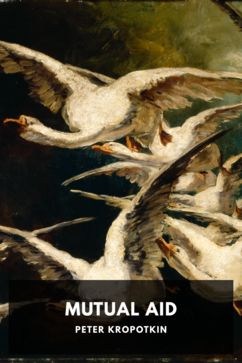
Mutual Aid - Peter Kropotkin
So, what's this book actually about? Forget a traditional plot. Think of it as a detective story where the mystery is: 'How do species, including humans, actually survive?' Kropotkin sets out to solve it, and his suspect is the popular idea of 'survival of the fittest' as constant war. Instead, he gathers his evidence. He looks at how animals form herds for protection, how birds migrate together, and how beavers build complex dams as a team. Then, he turns to us. He walks through human history, showing how mutual support wasn't just a nice idea but a practical necessity. He talks about medieval villages sharing fields, guilds supporting craftsmen, and communities banding together in hard times. The 'story' is his methodical, passionate case that mutual aid is a fundamental law of nature and a driving force in human progress.
Why You Should Read It
You should read this because it's the ultimate antidote to cynicism. In a world that often tells us it's 'every man for himself,' Kropotkin hands you a massive, well-researched counter-argument. It's not naive or fluffy. His points are grounded in observation and history. Reading it, I kept having moments where things just clicked. It gave me a new framework for understanding daily acts of kindness, local community projects, and even global movements. It argues that our instinct to cooperate is what built our societies, not just our instinct to compete. This book doesn't just live in the past; it makes you question how we live now and what we could build in the future.
Final Verdict
This book is perfect for the curious reader who feels like the standard narrative about competition is incomplete. It's for anyone interested in biology, history, politics, or sociology, but from a fresh angle. If you enjoy authors like Rebecca Solnit (who writes about communities in disaster) or Yuval Noah Harari (who looks at big human stories), you'll find a fascinating precursor here. Fair warning: it's from 1902, so some examples are dated, and the writing, while clear, is of its time. But the core idea is explosive and feels incredibly relevant. It's not a light beach read, but it is a truly mind-expanding one. Pick it up if you're ready to have your assumptions challenged in the best way possible.
This work has been identified as being free of known copyright restrictions. Thank you for supporting open literature.
Charles Hernandez
4 months agoI appreciate the objective tone and the evidence-based approach.
Anthony Brown
5 months agoTo be perfectly clear, the content flows smoothly from one chapter to the next. A valuable addition to my collection.
Charles Martin
1 year agoClear and concise.
Kimberly Thomas
5 months agoPerfect.


Kimberly Harris
5 months agoExceptional clarity on a very complex subject.