About 244 minutes
Gleanings from Maeterlinck — Themes and Context
Science Fiction Utopias
56,097 recorded words. 11 minutes difference from this book's estimate.
View Gutenberg source #67625
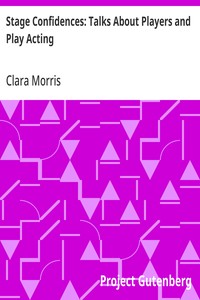
For Stage Confidences: Talks About Players and Play Acting — Reading Notes, the stored edition analysis reports 53,475 words, 3 hr 53 min estimated reading time, and 6 detected text sections.
The text analysis averages about 22.8 words per sentence, while the detected sections provide another way to judge how the source is divided.
Project Gutenberg metadata also associates the work with “Acting,” connecting these edition facts with the source record’s subject description.
Explore this collection
These alternatives are selected using recorded categories and estimated reading time.
About 244 minutes
Science Fiction Utopias
56,097 recorded words. 11 minutes difference from this book's estimate.
View Gutenberg source #67625About 217 minutes
Science Fiction Utopias
49,778 recorded words. 16 minutes difference from this book's estimate.
View Gutenberg source #33094About 263 minutes
Science Fiction Utopias
60,345 recorded words. 30 minutes difference from this book's estimate.
View Gutenberg source #53538Search stored excerpts and compare books → Choose by your preferences →
Choices use stored catalog measurements. Estimates vary with reading speed. A shared category is a catalog label, not a claim that two books have the same argument or literary quality.
Search reads excerpt text stored with this catalog and links to its associated Gutenberg record. The connection is stored in the site database; this tool does not recheck that every excerpt is word-for-word identical to that external record. Excerpt search does not cover every chapter and does not verify historical publication dates.
Catalog snapshot checked: 2026-09-25. Coverage: 96 public books, 96 available source excerpts.
Read the complete public-domain text at its original source.
Read on Project GutenbergClara Morris opens Stage Confidences by inventing a composite correspondent named 'Miss Hope Legion,' a device that allows her to address the many young women who wrote seeking advice about the stage. Rather than offering a systematic manual, she promises to mix warning with incident, and remonstrance with absurdity. The book's structure reflects this conversational, episodic approach: twenty-two chapters with titles like 'The Cat in Camille' and 'A Hole in the Wall Incident' signal that Morris will teach through stories, not precepts. Readers should expect a voice that is direct, sometimes wry, and unafraid to name specific colleagues, theatres, and embarrassing moments.
Morris begins by acknowledging that she cannot answer every letter she receives from aspiring actresses. Her solution is to create a single fictional addressee, 'Miss Hope Legion,' who embodies the varied temperaments and circumstances of her correspondents—'some grave, some gay, some well-off, some very poor.' This rhetorical strategy allows Morris to speak candidly without singling out any real person. She warns that she will prove assertions by incident and win laughter with absurdities that were painful in their happening. The opening thus establishes a tone of affectionate but unsentimental mentorship, grounded in lived experience rather than theory.
A representative chapter recounts a series of letters from a man signing himself 'Mr. A. Fix.' Morris dismisses the first as anonymous and overwrought, but the writer persists, describing his sleeplessness and near-accident while crossing a street. He announces he will attend the theatre and hold a white handkerchief high in his left hand so she can identify him. Morris reads the letter aloud in the greenroom, and actor Louis James orchestrates a prank: several actors enter carrying handkerchiefs, causing the audience to laugh at inappropriate moments. The anecdote turns when Mr. Fix writes again, not angrily, but offering to help Morris financially if she ever needs it. She admits she was wrong to assume his name was false and offers a belated apology. The story illustrates Morris's method—using a specific, embarrassing incident to explore the gap between theatrical cynicism and genuine feeling.
Morris's prose is colloquial and direct, full of dashes and exclamations that mimic spoken confidences. She addresses her reader as 'you' and refers to herself as 'I,' creating an intimate, one-sided conversation. The chapters are short and titled with vivid phrases—'The Cat in Camille,' 'A Belated Wedding'—that promise narrative rather than precept. Yet the book is not merely a collection of gossip; each anecdote serves a larger point about stage life, whether about the dangers of vanity, the realities of touring, or the ethics of practical jokes. The table of contents reveals a deliberate arc, moving from warning to specific productions to broader social conditions behind the scenes.
Because only the opening and one extended anecdote are available, the full range of Morris's advice remains unclear. The table of contents mentions chapters on 'The Stage as an Occupation for Women,' 'The Bane of the Young Actress's Life,' and 'Social Conditions Behind the Scenes,' suggesting that Morris addresses serious professional and moral questions. But the excerpts do not show how she handles those topics. Readers should not assume that the book is uniformly light or anecdotal; the presence of a chapter on 'The Actress and Religion' indicates a willingness to tackle subjects beyond the comic. The excerpts also give no sense of how Morris treats her fellow actors—whether she is consistently generous or occasionally sharp.
Morris's Stage Confidences rewards readers who enjoy theatre history told from the inside, with a narrator who is both participant and observer. The book is best approached not as a systematic guide but as a series of linked stories, each carrying a practical or moral point. Pay attention to the names and theatres Morris drops—Daly's, the Union Square, Salvini—as they anchor her anecdotes in a specific professional world. And note how often she returns to the theme of misjudgment, whether of a correspondent, a colleague, or an audience.
Reading Clara Morris’s gentle warnings about the stage’s illusions, I found myself drifting to Bierce’s letters — his sharp, lonely wit felt like the same ache, the same knowing that the spotlight never tells the whole truth. Both knew the cost of performance, onstage or off, and I lingered there awhile. The Letters of Ambrose Bierce, With a Memoir by George Sterling — Key Ideas to Explore holds a similar quiet resignation, as if we’re merely overhearing two old souls sigh.
Capture what you thought, learned, and would like to remember.