About 297 minutes
Wolfert's Roost, and Miscellanies — Themes and Context
Science Fiction Utopias
68,157 recorded words. 3 minutes difference from this book's estimate.
View Gutenberg source #8571
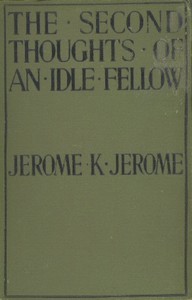
For The Second Thoughts of an Idle Fellow — A Reader’s Guide, the stored edition analysis reports 68,784 words, 5 hr estimated reading time, and 6 detected text sections.
The text analysis averages about 16.1 words per sentence, while the detected sections provide another way to judge how the source is divided.
Project Gutenberg metadata also associates the work with “English essays,” connecting these edition facts with the source record’s subject description.
Explore this collection
These alternatives are selected using recorded categories and estimated reading time.
About 297 minutes
Science Fiction Utopias
68,157 recorded words. 3 minutes difference from this book's estimate.
View Gutenberg source #8571About 281 minutes
Science Fiction Utopias
64,464 recorded words. 19 minutes difference from this book's estimate.
View Gutenberg source #42691About 323 minutes
Science Fiction Utopias
74,209 recorded words. 23 minutes difference from this book's estimate.
View Gutenberg source #36218Search stored excerpts and compare books → Choose by your preferences →
Choices use stored catalog measurements. Estimates vary with reading speed. A shared category is a catalog label, not a claim that two books have the same argument or literary quality.
Search reads excerpt text stored with this catalog and links to its associated Gutenberg record. The connection is stored in the site database; this tool does not recheck that every excerpt is word-for-word identical to that external record. Excerpt search does not cover every chapter and does not verify historical publication dates.
Catalog snapshot checked: 2026-09-25. Coverage: 96 public books, 96 available source excerpts.
Read the complete public-domain text at its original source.
Read on Project GutenbergJerome K. Jerome's The Second Thoughts of an Idle Fellow opens with a dialogue that dramatizes indecision: a woman vacillates between red and grey fabric, weighing hat compatibility and chinchilla trimmings. The passage captures a voice that is both patient and subtly mocking, as the assistant and friend offer circular advice. This essay collection, published in 1898, extends the persona of the 'idle fellow' from Jerome's earlier work, but here the tone is more varied—shifting from languid musing to brisk, exasperated exchanges. The excerpts reveal a writer attuned to the rhythms of everyday conversation, using repetition and interruption to comic effect.
The opening essay, 'On the Art of Making Up One's Mind,' establishes a pattern of stalling that recurs throughout the collection. The fabric-shop dialogue is built on a series of reversals: red is warm but clashes with a hat; grey is safe but uninteresting. Jerome renders the speaker's thought process in real time, with dashes and trailing sentences mimicking spoken hesitation. The friend's interjections—'Well then, why not have the red?'—only prolong the decision. This technique reappears in later essays, where characters second-guess gifts, plans, and opinions. Jerome does not resolve the indecision; he lets it spiral, suggesting that the act of choosing is itself a performance. The narrative voice remains detached, observing the comedy without moralizing.
In a later excerpt, a clubman complains about ill-considered gifts: a watercolour labelled 'Reverie' that he likens to influenza, a twelve-volume Tennyson with 'coloured photographs,' and a velvet smoking-jacket embroidered with forget-me-nots. Jerome's prose accelerates here, piling up examples in a single breathless paragraph. The speaker's irritation is rendered through hyperbole—'If I had seen a sky like that in Norfolk I should have taken the first train back to London'—and through precise, absurd details like the 'blue velvet bag capable of holding about a pound.' The voice shifts from the measured irony of the fabric scene to a more frantic, performative anger. This variation in pace, from leisurely to agitated, gives the collection its rhythmic texture.
Jerome's narrator is not a stable personality but a persona that adapts to each essay's target. In the gift-giving passage, he adopts the clubman's exasperated tone, complete with dashes and rhetorical questions: 'And why does it always take half-a-dozen people to serve you with a pair of gloves?' The voice is intimate, as if confiding in a friend, yet the details are carefully chosen for comic effect. The narrator's own fallibility emerges when he misremembers 'suede' as 'swedes,' and the shop assistant corrects him. This self-deprecating note undercuts any pretension to authority. Jerome uses the first-person plural ('we') sparingly, preferring a singular 'I' that is both confiding and unreliable. The essays thus feel like conversations overheard, with the narrator's mood shifting from essay to essay.
Readers approaching The Second Thoughts of an Idle Fellow will find a collection best taken in small doses, allowing each essay's distinct voice to register. The humour depends on recognizing the gap between what is said and what is meant—the fabric buyer who claims to prefer grey while eyeing red, the gift-giver who blames shopkeepers for his own poor choices. Jerome's prose rewards attention to its cadences: the long, looping sentences that mimic thought, and the sudden, punchy lines that land the joke.
I remember quite suddenly, whilst reading these second thoughts, the way my grandfather hesitated forever before choosing a single book for my birthday, his indecision as comical as Jerome’s. It reminded me of the same rambling warmth in Letters of Samuel Taylor Coleridge, Vol. 2 (of 2) — Reading Companion, where even his meandering apologies felt like generous company. Both make a sort of quiet art out of never quite getting to the point.
Capture what you thought, learned, and would like to remember.