
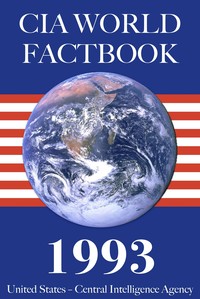
The 1993 CIA World Factbook by United States. Central Intelligence Agency
Let's be clear from the start: this is not a novel. There are no characters, no plot twists, and definitely no dialogue. The 'story' of The 1993 CIA World Factbook is the story of our world at a pivotal point in time. Published by the CIA's Directorate of Intelligence, this book was their unclassified reference for basic intelligence on every country recognized by the United States in 1993.
The Story
The book is organized alphabetically by country. Each entry is a rigidly formatted dossier of facts. You get a brief introduction, then sections on geography, people, government, economy, communications, and defense forces. It's all numbers, dates, and short, blunt statements. You'll find the exact coordinates of Afghanistan's capital, the percentage of arable land in Belgium, and the length of Chile's coastline. The 'narrative' emerges when you start connecting the dots yourself. Seeing the massive military expenditures of the US and Russia right after the Cold War, or noting which African nations were listed as having 'one-party states,' tells a bigger story about power and politics.
Why You Should Read It
I love this book for its sheer, unvarnished objectivity. There's no opinion, no spin—just the data the CIA analysts thought was most important for understanding a nation's reality. Flipping through it today is a surreal history lesson. You see countries that no longer exist (Yugoslavia, Zaire) and others just being born. You see pre-boom economic data for China and pre-collapse statistics for the Soviet Union. It’s a baseline. It lets you ask: 'What was this place like, right then?' It’s also weirdly grounding. In an age of information overload, there’s something calming about a simple, physical book that just states facts.
Final Verdict
This is a niche book, but a fascinating one. It's perfect for history buffs, trivia lovers, writers doing research, or anyone with a deep curiosity about how the world works. If you enjoy almanacs, maps, or getting lost in data, you'll find it endlessly browsable. It's not a page-turner; it's a thought-provoker. Keep it on your shelf, dip into it now and then, and travel back to a world that feels both familiar and incredibly distant.
The copyright for this book has expired, making it public property. You are welcome to share this with anyone.
John Lee
1 year agoBased on the summary, I decided to read it and it challenges the reader's perspective in an intellectual way. This story will stay with me.
Matthew Robinson
8 months agoWow.
Joseph Rodriguez
1 year agoThe index links actually work, which is rare!
Sandra Smith
1 year agoThis is one of those stories where the author's voice is distinct and makes complex topics easy to digest. I couldn't put it down.
Robert Lee
8 months agoI didn't expect much, but it manages to explain difficult concepts in plain English. Absolutely essential reading.