About 190 minutes
Old Junk — Inside the Classic
Science Fiction Utopias
43,673 recorded words. 6 minutes difference from this book's estimate.
View Gutenberg source #25523
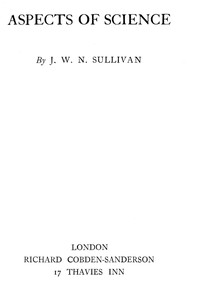
The source record for Aspects of science — Reading Companion measures this digital text at 44,884 words, 3 hr 16 min estimated reading time, and 26 detected text sections.
The text analysis averages about 24.8 words per sentence, while the detected sections provide another way to judge how the source is divided.
Project Gutenberg metadata also associates the work with “Science,” connecting these edition facts with the source record’s subject description.
Explore this collection
These alternatives are selected using recorded categories and estimated reading time.
About 190 minutes
Science Fiction Utopias
43,673 recorded words. 6 minutes difference from this book's estimate.
View Gutenberg source #25523About 217 minutes
Science Fiction Utopias
49,778 recorded words. 21 minutes difference from this book's estimate.
View Gutenberg source #33094About 233 minutes
Science Fiction Utopias
53,475 recorded words. 37 minutes difference from this book's estimate.
View Gutenberg source #13277Search stored excerpts and compare books → Choose by your preferences →
Choices use stored catalog measurements. Estimates vary with reading speed. A shared category is a catalog label, not a claim that two books have the same argument or literary quality.
Search reads excerpt text stored with this catalog and links to its associated Gutenberg record. The connection is stored in the site database; this tool does not recheck that every excerpt is word-for-word identical to that external record. Excerpt search does not cover every chapter and does not verify historical publication dates.
Catalog snapshot checked: 2026-09-25. Coverage: 96 public books, 96 available source excerpts.
Read the complete public-domain text at its original source.
Read on Project GutenbergJ. W. N. Sullivan opens his 1923 collection with a striking paradox: science, though born of irrational impulse, has progressed by serving deeply rooted human needs. The preface frames the book as an attempt to show why science may be interesting to nonspecialists, adopting what Sullivan calls an 'æsthetic' or 'humanistic' point of view. Rather than presenting a dry survey of discoveries, these essays treat scientific ideas as part of the general intellectual and emotional life of man, emphasizing their history and the human needs they arose to satisfy.
Sullivan's preface explicitly rejects the notion that science belongs only to specialists. He describes his point of view as 'æsthetic, but rather better as humanistic,' arguing that scientific ideas have a history and arose to satisfy certain human needs. This framing shapes every essay in the collection. In 'The Interest of Science,' he writes that 'the conception of science as a body of thought embracing the whole of our rational convictions about reality has hardly yet been generally reached.' He insists that dispassionate inquiry is welcomed only when the result is indifferent, and that nearly every great scientific generalisation has incurred hostility. The essays consistently treat science not as a set of facts but as a human activity shaped by passion, instinct, and cultural context.
Sullivan's prose is marked by aphoristic compression and a conversational, sometimes sardonic tone. In 'The Sceptic and the Spirits,' he writes: 'It is only youth that has the energy to be bothered with everything.' He describes the sceptic's state as 'a fine fleur of brief life, an exquisite tempering of the soul, neither too soft nor too hard, an infinite flexibility.' Such phrasing reveals a writer who values literary polish as much as argument. Elsewhere, he employs vivid metaphors: scientific men who adopt sides uncritically are compared to 'any simple dupe of the daily press,' and he accuses them of 'help[ing] beat the tom-toms' alongside witch-doctors. This rhetorical strategy—mixing learned allusion with blunt, almost colloquial attack—gives the essays a distinctive voice that is both authoritative and personal.
The collection's structure is loose, grouping twenty-six essays under thematic headings such as 'The Scientific Mind' and 'The Return of Mystery.' Each essay typically begins with a general observation or anecdote before narrowing to a specific critique or celebration. For instance, 'The Sceptic and the Spirits' opens with a meditation on aging and wisdom before turning to spiritualism as a test case for genuine scepticism. Sullivan often uses contrast: youth's noisy certainties versus age's mechanical wisdom, the true sceptic versus the dogmatist disguised as sceptic. This dialectical movement, moving from abstract principle to concrete example, gives each piece a self-contained argumentative arc while contributing to the book's overarching theme of science as a humanistic enterprise.
Several motifs recur across the essays. Sullivan repeatedly notes that 'on all questions where his passions are strongly engaged, man prizes certitude and fears knowledge.' He laments that scientific men themselves often adopt sides uncritically, behaving 'as any simple dupe of the daily press.' The essay 'The Sceptic and the Spirits' extends this critique to psychical research, suggesting that even ostensible inquirers may be less dispassionate than they claim. Sullivan's ideal scientific man would be 'at least as pervasively and constantly scientific as a good Jesuit is Roman Catholic.' This call for a committed, almost priestly scientific community appears alongside warnings against the 'method of charms and incantations' that he sees dominating public discourse. The tension between dispassionate inquiry and human passion is the collection's central preoccupation.
Readers approaching Aspects of Science should expect not a systematic treatise but a series of provocations, each essay rewarding attention to Sullivan's rhetorical craft as much as to his arguments. His willingness to name sacred cows—from spiritualism to the complacency of professional scientists—gives the book a bracing quality that remains fresh a century later. Those interested in the intersection of science, culture, and prose style will find much to admire in these pages.
I kept thinking about Sullivan’s quiet insistence that science carries its own beauty, not as proof, but as a kind of atmosphere. It reminded me of how Prejudices, first series — Background and Themes handles opinion—gently, like something you hold rather than argue. Both left me lingering on the texture of certainty, softer than I expected.
Use these questions to collect your thoughts before moving on.