About 365 minutes
The Letters of Charles Dickens. Vol. 3, 1836-1870 — A Closer Reading
Adventure Picaresque Fiction
83,731 recorded words. 7 minutes difference from this book's estimate.
View Gutenberg source #25854
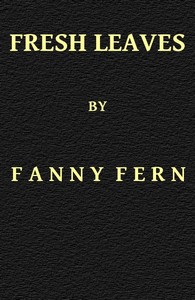
Before opening Fresh Leaves — Inside the Classic, the edition data offers a quick orientation: 85,485 words, 6 hr 12 min estimated reading time, and 11 detected text sections.
The text analysis averages about 22.5 words per sentence, while the detected sections provide another way to judge how the source is divided.
Project Gutenberg metadata also associates the work with “Short stories, American,” connecting these edition facts with the source record’s subject description.
Explore this collection
These alternatives are selected using recorded categories and estimated reading time.
About 365 minutes
Adventure Picaresque Fiction
83,731 recorded words. 7 minutes difference from this book's estimate.
View Gutenberg source #25854About 364 minutes
Adventure Picaresque Fiction
83,600 recorded words. 8 minutes difference from this book's estimate.
View Gutenberg source #19244About 349 minutes
Adventure Picaresque Fiction
80,050 recorded words. 23 minutes difference from this book's estimate.
View Gutenberg source #742Search stored excerpts and compare books → Choose by your preferences →
Choices use stored catalog measurements. Estimates vary with reading speed. A shared category is a catalog label, not a claim that two books have the same argument or literary quality.
Search reads excerpt text stored with this catalog and links to its associated Gutenberg record. The connection is stored in the site database; this tool does not recheck that every excerpt is word-for-word identical to that external record. Excerpt search does not cover every chapter and does not verify historical publication dates.
Catalog snapshot checked: 2026-09-25. Coverage: 96 public books, 96 available source excerpts.
Read the complete public-domain text at its original source.
Read on Project GutenbergFanny Fern's Fresh Leaves opens with a preface that directly addresses her 'parish' of readers, offering a new story alongside the celebrated 'hundred-dollar-a-column' piece and previously uncollected essays. The table of contents reveals a mix of narrative and commentary: titles like 'A Business Man’s Home; or, a Story for Husbands' and 'Feminine View of Napoleon as a Husband' signal Fern's interest in domestic and gender dynamics, while 'A Gauntlet for the Men' and 'To Gentlemen' suggest a confrontational tone.
The excerpts from the story 'Fanny Ford' show Fern's skill at blending sentiment with social critique. A peddler's encounter with a child named Fanny—who notes that her mother's picture 'never speaks back'—unfolds into a scene of concealed grief. The peddler's tears in the woods, 'stricken, smitten, on Nature’s kindly breast,' exemplify Fern's use of emotional excess to probe hidden sorrows.
The excerpt from 'Fanny Ford' introduces a peddler who, while making a wreath for a child, is visibly moved by her resemblance to someone he once knew. The child, also named Fanny, chatters about her dead mother and father, noting that 'mamma’s picture never speaks back.' The peddler's repeated touching of her hair and his whispered 'And I' in response to her claim that only grandma and God love her suggest a hidden connection. After leaving, he collapses in the woods, 'shedding such tears as manhood seldom sheds,' and the narrative reveals that the child is Mary's child but not his. Fern uses the child's innocent observations to heighten the pathos: the peddler 'hardly looked at' the mother's picture, a detail that underscores his avoidance of painful memories. The scene is a study in contrasts—the child's bright chatter versus the peddler's silent anguish—and it establishes a pattern of emotional revelation through small, telling gestures.
In a later excerpt, Fern shifts to a different register: the workshop of Mr. John Pray, a tailor who prides himself on fair wages. He examines Lucy's vests with approval, praising 'button-holes strong and even, lining smooth; stitching, like rows of seed pearl.' Pray's philosophy is explicit: he asks himself what he would consider fair pay if he had done the job, and he refuses to 'die with any body’s groans in my ears.' This passage reveals Fern's interest in economic justice and the dignity of skilled labor. The tailor's speech is colloquial and direct, with a moral weight that contrasts with the sentimentalism of the earlier scene. The mention of 'Zekiel' and the 'old lady' who sews the vests introduces a network of anonymous workers, and Pray's insistence on fair dealing—'weighed out in that ere pair of Bible scales'—ties commerce to conscience. Fern here moves from private grief to public ethics, suggesting that the same attention to human worth should govern both realms.
Across the excerpts, several details recur that reward close attention. The peddler's repeated touching of Fanny's hair—'Because it is so like—oh, well'—links physical touch to memory and loss. The child's mother's picture, which 'never speaks back,' becomes a symbol of absence and unspoken grief. Similarly, the peddler's silence about his past is mirrored in the child's grandmother, who is 'so deaf she can’t hear us,' creating a household where communication is partial and indirect. Fern also uses the motif of the 'wreath' as a fragile, handmade gift that carries emotional weight. These recurring elements—hair, portraits, silence—build a texture of longing and incomplete knowledge. The reader is left to infer the peddler's history from fragments: 'Mary—yet not Mary; Mary’s child—yet not his child!' This technique of withholding full explanation while offering vivid sensory details is characteristic of Fern's narrative style.
Fern's authorial voice, as glimpsed in the preface and the story excerpts, is notably direct and personal. She addresses her readers as 'my parish' and jokes about the 'hundred-dollar-a-column story' with a wink: 'My banker and I can afford to laugh!' This conversational tone carries into the fiction, where the narrator shifts between omniscient commentary and close focus on characters' inner states. In the peddler scene, the prose becomes almost breathless: 'Still in his ears lingered that bird-like voice, still in his veins thrilled the touch of that tiny hand.' The use of dashes and exclamations—'O, the sorrow written in every furrow of that kindly face, and—O God—by whom?'—creates a sense of urgency and emotional overflow. Fern's willingness to break into apostrophe and rhetorical question gives her writing a performative quality, as if she is speaking directly to the reader about the injustices and sorrows she depicts. This voice, at once intimate and indignant, is a key feature of Fresh Leaves.
Reading Fresh Leaves with attention to the interplay between its sentimental and satirical modes reveals Fern's range. The excerpts suggest that her fiction often hinges on unspoken backstories and economic realities, while her essays likely sharpen the critique of gender and labor hinted at in the table of contents. A first reader may find it useful to note how Fern balances pathos with pointed social observation, and how the same details—a touch, a picture, a wage—can carry both emotional and ethical weight.
Years among these shelves, I’ve often lingered over the peddler’s quiet heart in Fresh Leaves, where Fern finds grace in a child’s glance. That same unhurried tenderness—attention to small, inward things—marks the letters within Letters to the Clergy on the Lord's Prayer and the Church — Edition Insights, a gentle meeting of kindred spirits across a century.
A brief reflection can help important ideas stay with you longer.