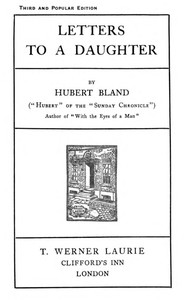
The first letter, dated October 17, establishes the collection's premise: Bland writes to his daughter Alexa while she is away, hoping to say things that face-to-face conversation made difficult. He sharpens his razor and his wits simultaneously, a metaphor for the candor he intends. The opening immediately defines the father-daughter bond as unique—'the only woman in all the world for whom a man five-and-twenty years her senior can feel no stir of passion'—and sets up a tone of affectionate but unsparing analysis.
Bland's voice is conversational yet deliberate, peppered with asides and self-deprecation. He warns that talking of love often ends 'in tears and temper,' and he positions himself as a writing man who can use letters to bypass emotional obstacles. The reader is thus primed for a series of intimate, essay-like epistles that blend personal reflection with broader social critique.
A Father's Unusual Confidante
The letters are addressed to 'My dear Alexa,' and Bland repeatedly acknowledges the peculiarity of their correspondence. He notes that his daughter is the only woman with whom he can discuss love without 'that complex emotion that modern novelists ... call sex-love.' This framing allows him to speak with unusual frankness about men's attitudes toward women. In the first letter, he dissects the gap between polite gallantry and genuine respect, observing that men 'do not love women' but rather 'love them as the hawk loves the pigeon.' He supports this with specific examples: men linger over wine after dinner rather than hurry to the drawing-room; they resist admitting women to their clubs; they carry parcels for attractive women but not for housemaids. These observations are grounded in the text's own details, not extrapolated beyond the excerpts.
The Rhetoric of the Razor
Bland's prose is marked by a deliberate, almost theatrical self-awareness. He begins the first letter by describing how comprehension 'came to me in a flash as I was stropping my razor this morning: the sharpening of one thing helped to sharpen another—my wits.' This image recurs in the collection's structure: each letter sharpens a particular argument. Bland frequently addresses Alexa directly, using her name to maintain intimacy, and he employs rhetorical questions ('Now I put it to you, does one satirise, ironise, slate, bully-rag ... the thing one loves?'). He also inserts brief narratives, such as the failed attempt to admit women to his club, which he recounts with wry humor. The voice is that of an experienced journalist—Bland wrote for the Sunday Chronicle—and the letters read like polished columns, each with a clear thesis and supporting anecdotes.
The Limits of the Epistolary Form
Bland is acutely aware that letters are not essays. In the opening, he resists the urge to write a 2000-word treatise on father-daughter relations, reminding himself that Alexa asked for letters, not essays. Yet the letters often verge on the essayistic, blending personal anecdote with general observation. The second excerpt, from 'The Man's Point of View,' shows Bland apologizing for upsetting Alexa with a previous letter, revealing that his candor sometimes causes distress. He recalls advice from a 'wise and wicked old man' about the dangers of speaking too plainly. This self-correction suggests that the collection is not a monologue but an ongoing dialogue, with Alexa's reactions shaping the father's subsequent responses. The reader is left to infer the daughter's side from the father's replies, a technique that creates a sense of incomplete but vivid exchange.
Social Critique Through Domestic Detail
Bland's observations are rooted in the domestic and social rituals of Edwardian England. He describes men's behavior after dinner—'the heavy reluctance with which we rise when the host gives the word'—and contrasts it with the polite attentiveness shown to women in public. He notes that men 'school our voices' to hide their true feelings. The club anecdote is particularly telling: Bland's proposal to admit women for tea 'almost ruined my reputation,' and the memory 'still clings to me like the traces of some fell disease.' These details ground the letters in a specific time and place, making the critique of gender relations concrete rather than abstract. The excerpts do not reveal whether Alexa agrees with her father, but they show a man who is both affectionate and unsparing in his analysis of his own sex.
These letters offer a first reading that is both intimate and analytical. Bland's voice is that of a father who loves his daughter but refuses to flatter her with easy pieties. The reader is invited to watch a mind at work—sharpening its arguments, testing its premises, and occasionally apologizing for its bluntness. The collection rewards attention to its rhetorical strategies: the use of direct address, the self-deprecating humor, and the careful balance between personal confession and social commentary. As a record of Edwardian father-daughter dynamics, it is unusually candid; as a set of letters, it is a performance of intimacy that never forgets its audience.
There’s something tender in Hubert Bland’s letters—that careful distance between what a father says and what a daughter knows. It made me think of The Curious Republic of Gondour, and Other Whimsical Sketches — A Reader’s Guide, where the same quiet observation of human folly lingers. Both feel like sitting in a lamplit room, turning pages slowly, half-smiling at how little we change.