About 34 minutes
Inaugural Presidential Address, Official Transcript — Story, Setting & Ideas
Historical Psychological Social Fiction
7,664 recorded words. 6 minutes difference from this book's estimate.
View Gutenberg source #28001
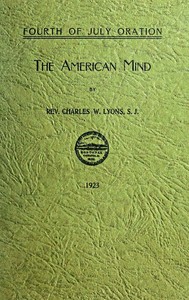
The source record for Oration: The American Mind — Edition Insights measures this digital text at 6,254 words, 28 min estimated reading time, and 4 detected text sections.
The text analysis averages about 14.0 words per sentence, while the detected sections provide another way to judge how the source is divided.
Project Gutenberg metadata also associates the work with “Fourth of July orations,” connecting these edition facts with the source record’s subject description.
Explore this collection
These alternatives are selected using recorded categories and estimated reading time.
About 34 minutes
Historical Psychological Social Fiction
7,664 recorded words. 6 minutes difference from this book's estimate.
View Gutenberg source #28001About 20 minutes
Historical Psychological Social Fiction
4,406 recorded words. 8 minutes difference from this book's estimate.
View Gutenberg source #3About 40 minutes
Historical Psychological Social Fiction
8,998 recorded words. 12 minutes difference from this book's estimate.
View Gutenberg source #857Search stored excerpts and compare books → Choose by your preferences →
Choices use stored catalog measurements. Estimates vary with reading speed. A shared category is a catalog label, not a claim that two books have the same argument or literary quality.
Search reads excerpt text stored with this catalog and links to its associated Gutenberg record. The connection is stored in the site database; this tool does not recheck that every excerpt is word-for-word identical to that external record. Excerpt search does not cover every chapter and does not verify historical publication dates.
Catalog snapshot checked: 2026-09-25. Coverage: 96 public books, 96 available source excerpts.
Read the complete public-domain text at its original source.
Read on Project GutenbergRev. Charles W. Lyons delivered this oration in Faneuil Hall on July 4, 1923, the 147th anniversary of the Declaration of Independence. The opening paragraphs immediately establish a reflective tone, urging listeners to “pause from the whirl of incessant activities” and “let the mind run sweetly and lovingly over a treasured past.” This framing invites the audience to consider national history as a source of moral continuity. Lyons then cites John Quincy Adams, Moses, Aristotle, and the Magna Carta, weaving a chain of precedents that positions American ideals as the culmination of long-developing thought. The excerpts show a speaker who grounds his argument in authoritative sources rather than personal sentiment.
The oration’s structure is built on accumulation. Lyons does not proceed chronologically but assembles quotations and references to show that the principles of 1776 were “not new thoughts or unknown emotions.” He draws on Deuteronomy (“There shall be no difference of persons”), Aristotle’s view of the state as a formation for human development, and the Magna Carta’s pledges of justice. The effect is to present the American founding as the latest expression of a universal moral trajectory. Readers should note how each citation reinforces the claim that the Declaration and Constitution are “parts of one constant whole.” The excerpts do not reveal whether Lyons extends this argument into contemporary policy, but the method is clear: the past is a reservoir of authority.
Lyons addresses his listeners as “children of a later generation” and personifies the country as a parent who “pleads that we follow this generous impulse of nature.” This rhetorical posture softens the didacticism of the historical references. The setting—Faneuil Hall, a site of revolutionary debate—adds weight to his words. The excerpts show a speaker who balances erudition with accessibility, using phrases like “sweetly and lovingly” to evoke emotion. The oration was published by the City of Boston Printing Department, indicating an official imprimatur. A first-time reader might consider how the physical context of delivery shapes the argument’s urgency.
A notable feature of this text is the extensive appendix listing previous Fourth of July orations in Boston from 1777 to 1923, compiled by C. W. Ernst. This bibliography, with notes on editions and reprints, transforms the single oration into a window onto a civic tradition. For example, the entry for 1914 notes Rev. James A. Supple’s “Religion: The Hope of the Nation,” while 1917 lists Daniel J. Gallagher’s “Americans Welded by War.” Readers can trace thematic shifts across decades. The appendix also includes footnotes on printing history, such as the “preliminary edition of twelve copies” for the 1863 oration. This paratextual material enriches the reading experience by situating Lyons’s address within a lineage of public discourse.
The excerpts provided are primarily from the opening and the appendix. The middle and later sections of the oration are not included, so the full arc of Lyons’s argument about “the American Mind” remains unknown. He may develop specific political or social applications, but the available text does not confirm this. Readers should approach the work as an incomplete record, focusing on the rhetorical strategies and historical scaffolding that are visible. The oration’s brevity—6,254 words—suggests a focused address, but without the complete text, one cannot assess its treatment of contemporary issues like immigration, labor, or world affairs. The editorial note advises caution against inferring a comprehensive thesis.
This oration rewards attention to its layered references and the civic ritual it represents. Readers interested in the evolution of American patriotic rhetoric will find the appendix a valuable resource, while those focused on Lyons’s own voice can study how he balances reverence for the past with the demands of a live audience. The incomplete excerpts remind us that a first reading is necessarily provisional; the full text may reveal shifts in tone or argument not captured here.
Reading the Oration’s editorial note, I found myself thinking of how Lyons measured a nation’s pulse in a single hall. It reminded me of another volume, one that wanders through similar quiet confidence without the ceremony. The same unhurried trust in ideas, just spoken differently. Idle Ideas in 1905 — Themes and Context feels like a morning after that speech.
Capture what you thought, learned, and would like to remember.