About 446 minutes
The Complete Works of Brann, the Iconoclast — Volume 01 — Reading Companion
Historical Psychological Social Fiction
102,420 recorded words. 12 minutes difference from this book's estimate.
View Gutenberg source #567
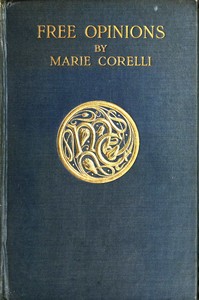
Free Opinions, Freely Expressed on Certain Phases of Modern Social Life and Conduct — A Reader’s Guide can be approached with a clearer sense of reading commitment from its source measurements: 99,601 words, 7 hr 14 min estimated reading time, and 10 detected text sections.
The text analysis averages about 26.7 words per sentence, while the detected sections provide another way to judge how the source is divided.
Project Gutenberg metadata also associates the work with “English essays -- 20th century,” connecting these edition facts with the source record’s subject description.
Explore this collection
These alternatives are selected using recorded categories and estimated reading time.
About 446 minutes
Historical Psychological Social Fiction
102,420 recorded words. 12 minutes difference from this book's estimate.
View Gutenberg source #567About 413 minutes
Historical Psychological Social Fiction
94,930 recorded words. 21 minutes difference from this book's estimate.
View Gutenberg source #37499About 400 minutes
Historical Psychological Social Fiction
91,934 recorded words. 34 minutes difference from this book's estimate.
View Gutenberg source #45450Search stored excerpts and compare books → Choose by your preferences →
Choices use stored catalog measurements. Estimates vary with reading speed. A shared category is a catalog label, not a claim that two books have the same argument or literary quality.
Search reads excerpt text stored with this catalog and links to its associated Gutenberg record. The connection is stored in the site database; this tool does not recheck that every excerpt is word-for-word identical to that external record. Excerpt search does not cover every chapter and does not verify historical publication dates.
Catalog snapshot checked: 2026-09-25. Coverage: 96 public books, 96 available source excerpts.
Read the complete public-domain text at its original source.
Read on Project GutenbergMarie Corelli opens her 1905 collection Free Opinions, Freely Expressed with a direct challenge to Archdeacon Sinclair's condemnation of London's morality, defending the city's millions against what she calls an unfair clerical broadside. This sets the combative, evidence-driven tone for thirty essays that tackle education, journalism, religion, and women's roles. Corelli writes as a public intellectual, marshaling specific incidents—such as male doctors resigning rather than accept a female house-surgeon—to argue that institutional prejudice, not female incapacity, blocks progress.
Corelli frames her defense of London by turning the accusation back on the clergy: she cites their own “open worldliness, and gross inattention to the spiritual needs of their congregations” as the real problem. This rhetorical move—using the opponent's charge as a mirror—recurs throughout the collection. In “Pagan London,” she insists that the city's poor are not irreligious but neglected, a claim she supports by naming Archdeacon Sinclair directly and referencing the public discussion the article provoked. The author's note reveals that eleven essays were written for an American syndicate, suggesting Corelli tailored her arguments for transatlantic audiences while reserving the London piece for domestic readers.
In the excerpt on education, Corelli abandons generalities for a numbered list of grievances: children forced into school at five, examined in mental arithmetic at four, subjected to needlework that damages eyesight, and disciplined through fear. She quotes Sir John Gorst on the risk of “addle their intellects” and “cripple their bodies.” The argument culminates in a call for women inspectors, grounded not in abstract rights but in maternal instinct and practical competence. Corelli is careful to distinguish this from support for women in Parliament, which she says she would “detest.” The specificity of the six-point indictment—desks, slates, corporal punishment—gives the essay a reformist, almost legislative character.
Corelli varies her pace between sustained argument and sharp anecdote. The hospital resignation story is told in a single sentence, its irony left to speak for itself: “sooner than honour a woman's ability, they preferred to resign.” Elsewhere, she uses numbered lists to create a sense of bureaucratic absurdity, as when she notes that male inspectors deplore “lack of mental arithmetic in a baby.” The voice is consistently assured, even combative, but never shrill. Corelli positions herself as a rational observer amid folly, a stance reinforced by her epigraph from Eugène Manuel: “Il faut que le lutteur / Affirme la justice.”
Corelli's essays reward readers who attend to her use of evidence: the named adversary, the quoted authority, the numbered grievance. She writes not as a detached commentator but as a participant in ongoing debates, and her collection preserves the texture of Edwardian social argument. Approaching Free Opinions as a series of tactical interventions—rather than a unified treatise—helps clarify the shifts in tone and target that give the book its restless energy.
Years ago, I shelved Corelli’s Free Opinions and felt her brisk, wounded certainty—how she pinched at Edwardian bluster. There’s a quieter companion, though, one that shares her taste for unmasking polite nonsense. When I close one, I often find myself touching the other’s spine, as if they’d been whispering between boards. Prejudices, second series — Key Ideas to Explore holds a similar, unhurried scorn, a familiar company for long evenings.
Use these questions to collect your thoughts before moving on.