About 249 minutes
Idle Ideas in 1905 — Themes and Context
Historical Psychological Social Fiction
57,217 recorded words. 16 minutes difference from this book's estimate.
View Gutenberg source #3140
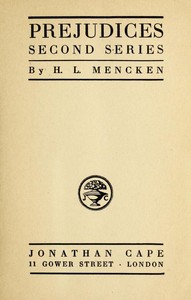
Before opening Prejudices, second series — Key Ideas to Explore, the edition data offers a quick orientation: 60,927 words, 4 hr 25 min estimated reading time, and 7 detected text sections.
The text analysis averages about 22.7 words per sentence, while the detected sections provide another way to judge how the source is divided.
Project Gutenberg metadata also associates the work with “Literature -- History and criticism,” connecting these edition facts with the source record’s subject description.
Explore this collection
These alternatives are selected using recorded categories and estimated reading time.
About 249 minutes
Historical Psychological Social Fiction
57,217 recorded words. 16 minutes difference from this book's estimate.
View Gutenberg source #3140About 282 minutes
Historical Psychological Social Fiction
64,858 recorded words. 17 minutes difference from this book's estimate.
View Gutenberg source #41820About 305 minutes
Historical Psychological Social Fiction
69,931 recorded words. 40 minutes difference from this book's estimate.
View Gutenberg source #37387Search stored excerpts and compare books → Choose by your preferences →
Choices use stored catalog measurements. Estimates vary with reading speed. A shared category is a catalog label, not a claim that two books have the same argument or literary quality.
Search reads excerpt text stored with this catalog and links to its associated Gutenberg record. The connection is stored in the site database; this tool does not recheck that every excerpt is word-for-word identical to that external record. Excerpt search does not cover every chapter and does not verify historical publication dates.
Catalog snapshot checked: 2026-09-25. Coverage: 96 public books, 96 available source excerpts.
Read the complete public-domain text at its original source.
Read on Project GutenbergMencken opens Prejudices, Second Series not with a manifesto but with a text: Emerson's 'The American Scholar,' which he promptly dismantles. The essayist treats the oration as a failed prophecy, noting that Emerson's 1837 call for literary independence produced, by Mencken's reckoning, little more than provincial bluster. This move—anchoring a broad cultural critique in a specific, dated document—establishes the volume's method. Mencken rarely argues abstractly; he prefers to hold up a concrete example, then bludgeon it until its inadequacies are exposed. The Emerson passage also reveals Mencken's ear for rhetorical inflation: he quotes Emerson's vision of poetry 'flaming in our zenith' and lets the grandiosity hang in the air, unremarked but unmistakably mocked.
The essay on Roosevelt, subtitled 'An Autopsy,' is the volume's most sustained performance in a mode Mencken perfected: the posthumous vivisection of a public figure. He does not narrate Roosevelt's life; instead, he dissects his style. Mencken notes Roosevelt's 'gigantic gusto' and 'superb aliveness' but immediately undercuts these with a catalog of defects: 'blatant, crude, overly confidential, devious, tyrannical, vainglorious, sometimes quite childish.' The rhythm of the list—short, blunt, accelerating—mimics a prosecutor's summation. Mencken's key insight is that Roosevelt's errors stemmed from his audience: 'aspiring to be the leader of a nation of third-rate men, he had to stoop to the common level.' This is not biography but a diagnosis of democratic leadership's inherent compromises.
'The Sahara of the Bozart' is Mencken's most famous essay in this collection, and its title announces its method: a vast, barren region defined by absence. He opens with a couplet from the obscure J. Gordon Coogler—'Alas, for the South! Her books have grown fewer'—and uses it as a launching pad for a catalogue of cultural deprivation. The prose itself enacts the emptiness it describes: long, sweeping sentences that accumulate examples of what the South lacks—poets, oboe-players, dry-point etchers, metaphysicians. Mencken's strategy is to define a culture by its deficits, a risky approach that succeeds through sheer rhetorical force. He compares the region to 'interstellar spaces' and 'the colossal reaches of the now mythical ether,' pushing the metaphor until it becomes absurd, then doubling down.
Mencken's sentences are his primary weapon, and their rhythms vary with his target. In the Roosevelt essay, he uses short, staccato clauses to convey impatience: 'The man was blatant, crude, overly confidential...' In 'The Sahara of the Bozart,' he favors longer, cumulative structures that mimic the sweep of his contempt. A typical sentence might begin with a flat assertion, then add qualifications, then pivot to a mocking simile, all before reaching the period. This syntactic restlessness keeps the reader off-balance, never sure whether the next clause will deliver a fact or a sneer. Mencken also varies paragraph length dramatically: a single, devastating sentence can stand alone as a paragraph, while others run to half a page of layered invective. The effect is of a mind working in real time, testing each idea before discarding it.
Readers approaching Prejudices, Second Series should attend to Mencken's tonal shifts: he can move from scholarly quotation to gutter slang within a single paragraph. The essays reward attention to his use of dashes, parentheses, and italics—typographical cues that signal irony or emphasis. Because the excerpts are incomplete, one cannot judge how Mencken structures longer arguments, but the pattern of opening with a specific text or figure and then expanding outward is consistent. Treat each essay as a performance, not a treatise; the pleasure is in watching the prose coil and strike.
Reading Mencken again, I keep noticing how he nails the moment when outrage curdles into weariness. It came back to me while leafing through old newspaper writing—the same fingerprints of haste and self-regard he deplored. There’s a strange comfort in The American Newspaper — Edition Insights, recognizing the echo. Some flaws are so permanent they feel almost like old friends, waiting quietly on the shelf between us and yesterday.
Use these questions to collect your thoughts before moving on.