About 599 minutes
The Letters of Charles Dickens. Vol. 2, 1857-1870 — Background and Themes
Science Fiction Utopias
137,543 recorded words. 46 minutes difference from this book's estimate.
View Gutenberg source #25853
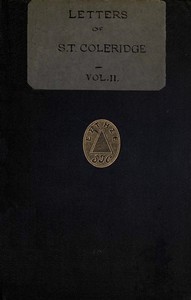
Letters of Samuel Taylor Coleridge, Vol. 2 (of 2) — Reading Companion can be approached with a clearer sense of reading commitment from its source measurements: 127,129 words, 9 hr 13 min estimated reading time, and 20 detected text sections.
The text analysis averages about 16.4 words per sentence, while the detected sections provide another way to judge how the source is divided.
Project Gutenberg metadata also associates the work with “Poets, English -- 19th century -- Correspondence,” connecting these edition facts with the source record’s subject description.
Explore this collection
These alternatives are selected using recorded categories and estimated reading time.
About 599 minutes
Science Fiction Utopias
137,543 recorded words. 46 minutes difference from this book's estimate.
View Gutenberg source #25853About 408 minutes
Science Fiction Utopias
93,749 recorded words. 145 minutes difference from this book's estimate.
View Gutenberg source #20539About 332 minutes
Science Fiction Utopias
76,225 recorded words. 221 minutes difference from this book's estimate.
View Gutenberg source #53474Search stored excerpts and compare books → Choose by your preferences →
Choices use stored catalog measurements. Estimates vary with reading speed. A shared category is a catalog label, not a claim that two books have the same argument or literary quality.
Search reads excerpt text stored with this catalog and links to its associated Gutenberg record. The connection is stored in the site database; this tool does not recheck that every excerpt is word-for-word identical to that external record. Excerpt search does not cover every chapter and does not verify historical publication dates.
Catalog snapshot checked: 2026-09-25. Coverage: 96 public books, 96 available source excerpts.
Read the complete public-domain text at its original source.
Read on Project GutenbergThis second volume of Coleridge's correspondence, edited by his grandson Ernest Hartley Coleridge, covers the years 1804 to 1819, a period marked by geographical displacement and intellectual ferment. The letters shift from detailed travel accounts during his absence in Malta to introspective reflections on memory, poetry, and philosophy upon his return to England. A striking feature is Coleridge's habit of annotating his own letters with symbols—such as Ɨ for greater pleasure and Θ for highest degree—as seen in his commentary on Blake's poems, where he assigns these marks to individual pieces. This editorial note focuses on the evolution of Coleridge's narrative voice and the changes in pace across the correspondence.
The early letters in this volume, written during Coleridge's long absence in Malta (1804–1806), are characterized by a brisk, observational tone. In a letter to Mrs. Coleridge dated June 1804, he describes his surroundings with a journalist's eye, noting details of landscape and society. The pace is steady, driven by the need to convey information across distance. However, as the volume progresses, particularly after his return to England in 1806, the letters become more introspective and digressive. A letter to Daniel Stuart from August 1806 shows Coleridge reflecting on his own mental processes, describing a "specific catalepsy of memory" that causes him to forget names. This shift from external to internal focus slows the narrative pace, inviting the reader into Coleridge's labyrinthine thought processes.
One of the most distinctive passages in the volume is Coleridge's extended critique of William Blake's poems and illustrations, included in a letter to Charles Augustus Tulk. Here, Coleridge's voice becomes analytical and precise, employing a specialized vocabulary to describe Blake's visual art. He notes "the faulty despotism in symbols" and "the lumpness (the effect of vinegar on an egg)" in certain figures, while praising the "master learned in his art" evident in other plates. This section stands out for its change in pace: the prose becomes denser, more technical, and deliberately paced, as Coleridge weighs each element. His use of a personal grading system—I, Ɨ, ƗƗ, Θ, O—adds a methodical layer to the critique, revealing a systematic mind at work even in private correspondence.
Throughout the volume, Coleridge repeatedly returns to the theme of his own memory failures, often with a blend of humor and frustration. In a letter to Tulk, he recounts a conversation with Mr. and Mrs. Gillman about a forgotten name, attributing his lapse to a "specific catalepsy of memory" and the "accidentality" of the encounter. This self-diagnosis recurs in other letters, creating a motif that ties together disparate correspondences. The pace of these passages varies: sometimes Coleridge narrates the incident briskly, as if to dismiss it, while at other times he lingers on the psychological explanation, slowing the prose to a reflective crawl. This oscillation between anecdote and analysis gives the volume a distinctive rhythm, mirroring Coleridge's own restless intellect.
Readers approaching this volume should attend to the interplay between Coleridge's public and private voices. The letters to editors like Daniel Stuart often adopt a more formal tone, while those to family and friends reveal a more vulnerable, self-questioning writer. The changes in pace—from the rapid travel narratives to the measured critiques of Blake—offer a window into Coleridge's evolving concerns. This edition, with its careful annotations by his grandson, provides a rich context for tracing these shifts, though the excerpts leave many letters only partially represented.
That grey afternoon, Coleridge’s letters wandered from travel to doubt, his own memory slipping like rain on glass. I closed the volume, and my gaze drifted to the shelf, where a thinner spine waited—a quiet meditation on pace and place. It felt less like a choice than the next step on a wet path. Walking — A Reader’s Guide seemed to answer something he’d left unsaid.
Create a short personal record of your experience with this book.