About 323 minutes
The Letters of Ambrose Bierce, With a Memoir by George Sterling — Key Ideas to Explore
Science Fiction Utopias
74,209 recorded words. 9 minutes difference from this book's estimate.
View Gutenberg source #36218
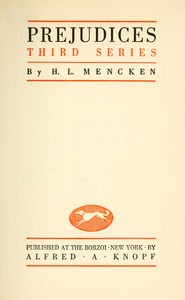
For Prejudices, third series — Themes and Context, the stored edition analysis reports 76,225 words, 5 hr 32 min estimated reading time, and 9 detected text sections.
The text analysis averages about 23.5 words per sentence, while the detected sections provide another way to judge how the source is divided.
Project Gutenberg metadata also associates the work with “Literature -- History and criticism,” connecting these edition facts with the source record’s subject description.
Explore this collection
These alternatives are selected using recorded categories and estimated reading time.
About 323 minutes
Science Fiction Utopias
74,209 recorded words. 9 minutes difference from this book's estimate.
View Gutenberg source #36218About 300 minutes
Science Fiction Utopias
68,784 recorded words. 32 minutes difference from this book's estimate.
View Gutenberg source #1915About 297 minutes
Science Fiction Utopias
68,157 recorded words. 35 minutes difference from this book's estimate.
View Gutenberg source #8571Search stored excerpts and compare books → Choose by your preferences →
Choices use stored catalog measurements. Estimates vary with reading speed. A shared category is a catalog label, not a claim that two books have the same argument or literary quality.
Search reads excerpt text stored with this catalog and links to its associated Gutenberg record. The connection is stored in the site database; this tool does not recheck that every excerpt is word-for-word identical to that external record. Excerpt search does not cover every chapter and does not verify historical publication dates.
Catalog snapshot checked: 2026-09-25. Coverage: 96 public books, 96 available source excerpts.
Read the complete public-domain text at its original source.
Read on Project GutenbergMencken launches the third series of Prejudices with a characteristically provocative salvo: he declares the U.S. government “ignorant, incompetent, corrupt, and disgusting,” exempting no more than twenty lawmakers and thirty judges. This opening essay, “On Being an American,” sets the tone for the collection—a blend of hyperbolic indictment and sardonic self-awareness. Mencken admits that his complaints may outstrip even those of the “Young Intellectuals” fleeing to Europe, yet he frames his own critique as a matter of “firmest and most sacred beliefs” reached through “incessant prayer and meditation.” The reader is thus primed for a work that treats serious subjects with theatrical irreverence, where the line between genuine outrage and rhetorical performance is deliberately blurred.
In “The Poet and His Art,” Mencken offers a revealing self-portrait. He recalls once calling himself a “poetry-hater” after reading “sixty or seventy volumes of bad verse,” but he now insists the label was absurd. Poetry, he argues, is a “capital medicine” for moments of “intellectual and spiritual fatigue.” Its value lies not in grand themes but in craftsmanship: “a sound sonnet is almost as pleasing an object as a well-written fugue.” He admires Shakespeare not for profundity but for technical mastery—the “music” and “air” with which he worked. This passage illuminates Mencken’s critical method: he judges art by workmanship, not message, and he is unafraid to contradict his own earlier pronouncements.
The essay on Abraham Lincoln in “Five Men at Random” exemplifies Mencken’s approach to biography. He laments that no “first-rate life” of Lincoln exists, despite an endless stream of Lincolniana. As evidence, he cites the unresolved question of Lincoln’s religious faith. Mencken reviews the Rev. William E. Barton’s The Soul of Abraham Lincoln, noting that Barton fails to settle whether Lincoln believed in Christ’s divinity. Mencken speculates that Lincoln’s “politeness” on the subject was that of “a politician in need of Christian votes.” He contrasts Barton’s argument—that Lincoln’s atheism was merely a rejection of “idiotic Methodist and Baptist dogmas”—with the testimony of close friends like Herndon, who maintained Lincoln was an atheist. Mencken leaves the matter open, using the case to illustrate the inadequacy of American biographical writing.
The section “Types of Men” presents a series of miniature character sketches, each a few paragraphs long. Mencken catalogs the Romantic, the Skeptic, the Believer, the Worker, the Physician, the Scientist, the Business Man, the King, the Average Man, the Truth-Seeker, the Pacifist, the Relative, and the Friend. These are not neutral descriptions but pointed caricatures. The Skeptic, for instance, is defined by his refusal to accept easy answers; the Business Man is portrayed as driven by narrow self-interest. The taxonomy reveals Mencken’s method of social criticism through typology—reducing complex human behavior to a set of recognizable, often contemptible, types. The entries are concise, aphoristic, and designed to provoke rather than inform.
In “The Forward-looker,” Mencken turns his attention to progressive optimism, a favorite target. He dissects the figure who believes in inevitable human improvement, treating such faith as a form of superstition. The essay is typical of Mencken’s polemical style: he uses exaggerated claims and ironic reversals to undermine his opponent’s position. Elsewhere, “The Dismal Science” takes on economics, and “Matters of State” examines social contract theory and minority rights. Throughout, Mencken maintains a consistent voice—combative, learned, and deliberately offensive. His arguments are less systematic than performative, designed to display intellectual agility and to unsettle conventional pieties.
Reading Prejudices, Third Series requires tolerance for contradiction: Mencken denounces American culture while reveling in its absurdities, and he champions craftsmanship while indulging in rhetorical excess. The essays reward attention to his shifting tones—from mock solemnity to genuine irritation. A first-time reader may find the opening essay’s broadsides overwhelming, but the later pieces on poetry and biography offer a more nuanced view of Mencken’s critical principles. Approach the collection as a series of intellectual performances rather than a unified argument.
Rereading Prejudices, Third Series this afternoon, I found myself slowing down over Mencken’s restless complaints about the world’s sheer foolishness—and thinking, oddly, of Coleridge’s letters, where the same ache for order shows up as melancholy. His private pages feel like an older, gentler cousin to that bluster: both men, in their own ways, just trying to make sense of a noisy room. Letters of Samuel Taylor Coleridge, Vol. 2 (of 2) — Reading Companion stayed with me long after I closed it.
Capture what you thought, learned, and would like to remember.