About 199 minutes
The Idle Thoughts of an Idle Fellow — Context and Discussion
Fantasy Juvenile Worlds
45,698 recorded words. 4 minutes difference from this book's estimate.
View Gutenberg source #849
For Of All Things — Edition Insights, the stored edition analysis reports 46,469 words, 3 hr 23 min estimated reading time, and 6 detected text sections.
The text analysis averages about 20.8 words per sentence, while the detected sections provide another way to judge how the source is divided.
Project Gutenberg metadata also associates the work with “Essays,” connecting these edition facts with the source record’s subject description.
Explore this collection
These alternatives are selected using recorded categories and estimated reading time.
About 199 minutes
Fantasy Juvenile Worlds
45,698 recorded words. 4 minutes difference from this book's estimate.
View Gutenberg source #849About 212 minutes
Fantasy Juvenile Worlds
48,624 recorded words. 9 minutes difference from this book's estimate.
View Gutenberg source #33997About 154 minutes
Fantasy Juvenile Worlds
35,403 recorded words. 49 minutes difference from this book's estimate.
View Gutenberg source #1669Search stored excerpts and compare books → Choose by your preferences →
Choices use stored catalog measurements. Estimates vary with reading speed. A shared category is a catalog label, not a claim that two books have the same argument or literary quality.
Search reads excerpt text stored with this catalog and links to its associated Gutenberg record. The connection is stored in the site database; this tool does not recheck that every excerpt is word-for-word identical to that external record. Excerpt search does not cover every chapter and does not verify historical publication dates.
Catalog snapshot checked: 2026-09-25. Coverage: 96 public books, 96 available source excerpts.
Read the complete public-domain text at its original source.
Read on Project GutenbergRobert Benchley's Of All Things (1921) opens with a preface that is itself a joke: the full text of the Declaration of Independence, signed "R.C.B." and dated from a fictional address. This deadpan appropriation sets the tone for a collection where the author adopts the voice of a baffled investigator, treating trivial annoyances—like a restaurant check itemized to the penny—as if they were matters of grave scientific inquiry. The essays, originally published in Vanity Fair, Collier's, and other periodicals, are unified by a persona that is simultaneously pompous and helpless, a stance that allows Benchley to mine humor from the gap between grand language and mundane reality.
Benchley's narrators frequently adopt the cadence of a lecturer or a government report, only to apply it to subjects that resist such treatment. In the essay on the community masque, he parodies the breathless enthusiasm of Percy Mackaye's pageantry by describing a plot in which "the young girl Civilization" is pursued by "the evil spirit, Indigestion." The mock-heroic tone is sustained by cataloging allegorical figures—"Spirits of Capillary Attraction" and "Indestructibility of Matter"—as if they were standard dramatis personae. Elsewhere, the preface's borrowed Declaration of Independence treats the act of writing a book as a political revolution, complete with grievances against a "King of Great Britain" who is never mentioned again. This technique of ventriloquizing official language for trivial ends recurs throughout, creating a running commentary on the absurdity of expertise itself.
Benchley's humor often depends on the meticulous enumeration of petty expenses. In one excerpt, a meal of roast beef is broken down into its constituent costs: "Cover, 25c." and "Potatoes, 30c.," culminating in a total of $1.70 after tips. The narrator's tone is that of a forensic accountant, but the underlying complaint is the universal frustration of hidden fees. This attention to the granular details of consumption—the waiter's fee, the hat-boy's tip—turns a simple dinner into a case study in economic exploitation. The essay on the community masque similarly itemizes the components of a pageant: "Boy Scout uniforms," "a Goddess of Liberty costume," and "Red Cross regalia, left over from the war drives." By treating these props as evidence of a larger social pathology, Benchley transforms the mundane into the ridiculous.
Many of Benchley's sketches depict social situations that inevitably go wrong. The community masque essay imagines a suburban town, Wimblehurst, where the attempt to substitute pageantry for war leads to the same petty rivalries and organizational chaos as any amateur theatrical. The narrator's deadpan suggestion that the slogan should be "Fight Your Neighbors First" undercuts the idealistic premise. Similarly, the restaurant scene implies a social contract that is violated by the itemized bill—the narrator is "reconciled" until the check arrives. Benchley's characters are perpetually outmaneuvered by systems (restaurants, pageants, even the act of writing a preface) that promise order but deliver confusion. The humor arises from the gap between the narrator's expectation of competence and the reality of incompetence, whether his own or others'.
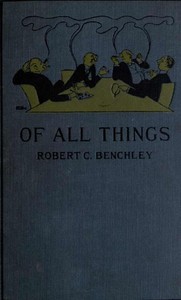
The illustrations by Gluyas Williams are integral to the book's effect. Williams' drawings typically depict a single figure—often a bewildered everyman—in a sparse setting, with exaggerated expressions that mirror Benchley's narrative persona. The cover and interior images reinforce the tone of dignified bafflement. In the community masque essay, one can imagine a drawing of a man in a toga and pince-nez, representing the Spirit of Something or Other, standing awkwardly on a village green. Williams' style, with its clean lines and subtle caricature, complements Benchley's prose without overwhelming it. The collaboration between writer and illustrator creates a unified comic world where the visual and verbal jokes operate in tandem, each amplifying the other's absurdity.
Readers approaching Of All Things should attend to the way Benchley uses the rhythms of formal discourse—the lecture, the report, the declaration—to frame the most trivial of complaints. The humor is cumulative, built from repeated patterns of deflation and exaggeration. Williams' illustrations serve as a visual anchor, reminding the reader that the narrator's pomposity is always undercut by his circumstances. This is not a book of jokes so much as a sustained performance of a character who is both the source and the butt of the comedy.
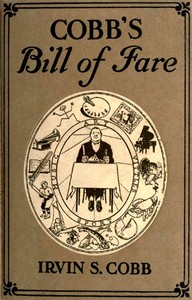
That rainy afternoon, Benchley’s deadpan grocery lists somehow matched the drumming on my window, his mock-serious fuss over trifles turning cozy. Gluyas Williams’ little figures felt like old friends. Later, flipping pages, I landed on a similar voice in another collection, one treating menus with the same affectionate gravity: Cobb's Bill-of-Fare — Themes and Context. It felt less like discovery, more like overhearing a familiar joke at the next table.
Create a short personal record of your experience with this book.