About 125 minutes
Life's Minor Collisions — Reading Companion
Science Fiction Utopias
28,602 recorded words. 8 minutes difference from this book's estimate.
View Gutenberg source #37899
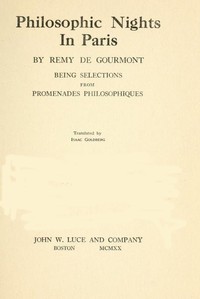
For Philosophic Nights in Paris Being selections from Promenades Philosophiques — Background and Themes, the stored edition analysis reports 26,842 words, 1 hr 57 min estimated reading time, and 3 detected text sections.
The text analysis averages about 20.0 words per sentence, while the detected sections provide another way to judge how the source is divided.
Project Gutenberg metadata also associates the work with “Philosophy,” connecting these edition facts with the source record’s subject description.
Explore this collection
These alternatives are selected using recorded categories and estimated reading time.
About 125 minutes
Science Fiction Utopias
28,602 recorded words. 8 minutes difference from this book's estimate.
View Gutenberg source #37899About 91 minutes
Science Fiction Utopias
20,821 recorded words. 26 minutes difference from this book's estimate.
View Gutenberg source #3278About 155 minutes
Science Fiction Utopias
35,544 recorded words. 38 minutes difference from this book's estimate.
View Gutenberg source #73390Search stored excerpts and compare books → Choose by your preferences →
Choices use stored catalog measurements. Estimates vary with reading speed. A shared category is a catalog label, not a claim that two books have the same argument or literary quality.
Search reads excerpt text stored with this catalog and links to its associated Gutenberg record. The connection is stored in the site database; this tool does not recheck that every excerpt is word-for-word identical to that external record. Excerpt search does not cover every chapter and does not verify historical publication dates.
Catalog snapshot checked: 2026-09-25. Coverage: 96 public books, 96 available source excerpts.
Read the complete public-domain text at its original source.
Read on Project GutenbergRemy de Gourmont's Philosophic Nights in Paris, translated by Isaac Goldberg, opens with an introduction that positions the author as a "neo-Epicurean" who combined "matter and manner" in his thought. The essays themselves, however, quickly move beyond abstract philosophy into concrete, often brutal natural observation. In the section on Leopardi, Gourmont quotes the Italian poet's description of a garden as a "vast hospital," where a rose is "wounded by the sun" and a lily is "sucked by a bee." Gourmont then corrects Leopardi's entomology: the mosquitoes he saw attacking caterpillars are actually ichneumons, laying eggs that will "gnaw the living flesh" of their prey. This blend of literary critique and precise natural history is characteristic of the collection.
Gourmont's essay on Leopardi is not a simple summary but a pointed argument. He reproduces Leopardi's claim that every plant in a garden is in a "state of suffering," then accuses the poet of committing "the error of him who wishes to prove too much." Gourmont insists that Leopardi's pessimism "abdicates reason" and becomes "somewhat ridiculous sentimentality." The key move is Gourmont's entomological correction: the mosquitoes Leopardi saw as allies of caterpillars are actually parasitic ichneumons. This detail transforms the garden from a passive hospital into an active battlefield where "every living creature is in turn prey and depredator." Gourmont's critique is not merely literary; it uses scientific observation to challenge a philosophical stance.
Gourmont traces pessimism back to ancient sources, noting that "the Greeks, who knew everything, knew the despair of living." He cites Pliny the Elder's enumeration of human miseries, including the observation that man "cries from the moment of birth and never laughs before his fortieth day." Pliny's conclusion, approving the epigram "It is best not to be born or to die as soon as possible," is presented as a precursor to Leopardi. Yet Gourmont distinguishes between Pliny's "beautiful and philosophic" resignation and Leopardi's more emotional version. This historical framing situates the essays within a tradition of philosophical reflection on suffering, while also asserting Gourmont's own critical distance from modern pessimism.
Isaac Goldberg's introduction, though not by Gourmont, shapes how the essays are presented. Goldberg describes Gourmont as "a daring, independent, unostentatious, extremely personal neo-Epicurean" who "outgrew" the Symbolist movement. He emphasizes Gourmont's "intellectual poise" and his ability to combine "matter and manner." The introduction also notes that Gourmont "was, by heredity and by choice, an aristocratic spirit" who later recognized "the importance of true democracy." This framing may influence readers to see the essays as the work of a detached, evolving thinker. However, the excerpts themselves show a writer deeply engaged in polemic, not aloof from his subjects.
Readers should approach Philosophic Nights in Paris as a series of arguments rather than a unified treatise. Gourmont's method is to engage with other thinkers—Leopardi, Pliny, Jouffroy—by testing their ideas against his own observations of nature and literature. The catalog subjects of "philosophy" and "French essays" are accurate but incomplete; the work also demands attention to its scientific details and its combative tone. Goldberg's translation preserves the essayist's voice, but the introduction's portrait of a serene "neo-Epicurean" may mislead. The essays themselves are sharper and more specific.
Some nights, after reading Gourmont’s quiet meditations on pessimism, I kept thinking how strange it is that we return to certain sorrows—not to fix them, but to feel understood. It reminded me of Lincoln’s own words, which carry that same weary tenderness, spoken when the war was nearly over. I left Abraham Lincoln's Second Inaugural Address — Text and Context open on my desk for days, just sitting with its ache.
Create a short personal record of your experience with this book.