About 295 minutes
The philosophy of Jake Haiden (late Jacob K. Huff) — A Closer Reading
Adventure Picaresque Fiction
67,850 recorded words. 15 minutes difference from this book's estimate.
View Gutenberg source #74444
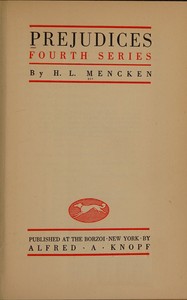
This digital edition of Prejudices, fourth series — Edition Insights is described by source-level measurements including 71,077 words, 5 hr 10 min estimated reading time, and 22 detected text sections.
The text analysis averages about 23.9 words per sentence, while the detected sections provide another way to judge how the source is divided.
Project Gutenberg metadata also associates the work with “Literature -- History and criticism,” connecting these edition facts with the source record’s subject description.
Explore this collection
These alternatives are selected using recorded categories and estimated reading time.
About 295 minutes
Adventure Picaresque Fiction
67,850 recorded words. 15 minutes difference from this book's estimate.
View Gutenberg source #74444About 289 minutes
Adventure Picaresque Fiction
66,407 recorded words. 21 minutes difference from this book's estimate.
View Gutenberg source #26320About 344 minutes
Adventure Picaresque Fiction
79,009 recorded words. 34 minutes difference from this book's estimate.
View Gutenberg source #52356Search stored excerpts and compare books → Choose by your preferences →
Choices use stored catalog measurements. Estimates vary with reading speed. A shared category is a catalog label, not a claim that two books have the same argument or literary quality.
Search reads excerpt text stored with this catalog and links to its associated Gutenberg record. The connection is stored in the site database; this tool does not recheck that every excerpt is word-for-word identical to that external record. Excerpt search does not cover every chapter and does not verify historical publication dates.
Catalog snapshot checked: 2026-09-25. Coverage: 96 public books, 96 available source excerpts.
Read the complete public-domain text at its original source.
Read on Project GutenbergH. L. Mencken's Prejudices, Fourth Series (1924) opens with an essay on "The American Tradition" that immediately undercuts the catalog subject of "Literature -- History and criticism." Rather than analyzing literary texts, Mencken uses the tradition as a springboard to attack Puritanism and Prohibition, arguing that the Eighteenth Amendment passed due to war hysteria, not popular will. He coins the term "Homo boobiens" to describe the easily manipulated citizen, and compares the Anti-Saloon League's success to a "fly in imperishable amber." The volume's twenty-two essays range from marriage to politics, but consistently return to the theme of democratic incompetence.
In "Meditations in the Methodist Desert," Mencken offers a case study of Puritan psychology that goes beyond mere criticism of Prohibition. He observes that "what a Puritan advocates and what he does have no necessary connection," citing Anthony Comstock's habit of collecting the very obscene books he suppressed. This paradox—that moral crusaders often indulge in the vices they condemn—becomes a recurring motif. Mencken's evidence is drawn not from literary sources but from contemporary political behavior, particularly the wartime propaganda that turned German brewers into national enemies. The essay "The Husbandman" extends this critique to rural America, portraying farmers as beneficiaries of sentimental myth rather than independent thinkers. Mencken's method is to expose the gap between stated ideals and actual conduct, using specific examples like the American Legion's lingering "war psychosis."
The volume's structure reveals Mencken's rhetorical strategy. Many essays, such as "Reflections on Human Monogamy" and "From a Critic's Notebook," are divided into numbered subsections—fifteen in the former, five in the latter—that function as aphoristic strikes rather than sustained arguments. This fragmentation mirrors his view of modern life as a series of absurdities best captured in short, epigrammatic bursts. In "The Politician," he shifts to a more continuous prose style, but the content remains episodic, cataloging the politician's vices without offering a systematic theory. The catalog subjects list "American essays — 20th century," but Mencken's essays often resemble extended editorials or satirical sketches more than formal literary criticism. His targets are not books but institutions: marriage, democracy, religion, and the press.
The excerpts provided offer concrete evidence of Mencken's voice and method. In the Prohibition essay, he uses the phrase "voluptuous consumption of alcohol" to mock both the pleasure and the legal prohibition. He invents the term "Methodist millennium" to describe the ideal of religious reformers, and refers to the Constitution as containing "the first article of the Methodist Book of Discipline." These are not neutral observations but deliberate provocations. The catalog subject "Literature -- History and criticism" is misleading: Mencken rarely discusses literature in this volume. Instead, he applies a literary critic's attention to language and rhetoric to political and social phenomena. His targets are specific: the Anti-Saloon League, Anthony Comstock, the American Legion, and the "Puritan psyche." The excerpts show no engagement with novels, poems, or plays; the closest he comes to literary criticism is in "From a Critic's Notebook," which offers brief, cynical maxims about art and artists.
Readers approaching Prejudices, Fourth Series should set aside expectations of literary criticism. Mencken's project is cultural diagnosis through satire, and his evidence is drawn from newspapers, political speeches, and everyday observation. The volume rewards attention to his recurring rhetorical devices: invented Latin terms, ironic capitalization, and the relentless exposure of hypocrisy. Each essay can be read as a self-contained performance, but together they build a coherent indictment of American democracy in the 1920s.
Reading Mencken’s sharp dismissals of Puritanism, I remembered sitting on my grandmother’s porch, her quiet disdain for small-town gossip. That same weary recognition surfaced in Records of Later Life — Reading Notes, where the author’s gentle resignation over human pettiness felt like a balm after his thunder. Both books, in their own temperaments, simply watched people be themselves. It was oddly comforting, that shared, unsentimental patience.
Capture what you thought, learned, and would like to remember.