About 30 minutes
Abraham Lincoln's First Inaugural Address — Reading Companion
Fantasy Juvenile Worlds
6,691 recorded words. 2 minutes difference from this book's estimate.
View Gutenberg source #9
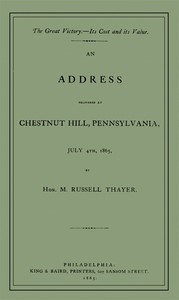
The catalog record for The Great Victory—Its Cost and Its Value Address delivered at Chestnut Hill, Pennsylvania, July 4th, 1865 — Inside the Classic provides practical reading context through 7,269 words, 32 min estimated reading time, and 4 detected text sections.
The text analysis averages about 24.2 words per sentence, while the detected sections provide another way to judge how the source is divided.
Project Gutenberg metadata also associates the work with “United States -- History -- Civil War, 1861-1865,” connecting these edition facts with the source record’s subject description.
Explore this collection
These alternatives are selected using recorded categories and estimated reading time.
About 30 minutes
Fantasy Juvenile Worlds
6,691 recorded words. 2 minutes difference from this book's estimate.
View Gutenberg source #9About 30 minutes
Fantasy Juvenile Worlds
6,861 recorded words. 2 minutes difference from this book's estimate.
View Gutenberg source #28784About 41 minutes
Fantasy Juvenile Worlds
9,344 recorded words. 9 minutes difference from this book's estimate.
View Gutenberg source #43809Search stored excerpts and compare books → Choose by your preferences →
Choices use stored catalog measurements. Estimates vary with reading speed. A shared category is a catalog label, not a claim that two books have the same argument or literary quality.
Search reads excerpt text stored with this catalog and links to its associated Gutenberg record. The connection is stored in the site database; this tool does not recheck that every excerpt is word-for-word identical to that external record. Excerpt search does not cover every chapter and does not verify historical publication dates.
Catalog snapshot checked: 2026-09-25. Coverage: 96 public books, 96 available source excerpts.
Read the complete public-domain text at its original source.
Read on Project GutenbergThayer opens his 1865 address by drawing a deliberate parallel between ancient Roman victory rites and the American celebration of July 4th, yet immediately pivots to insist that this peace is "not wrung from our fears or built upon our dishonor." His syntax—a cascade of negations—rejects compromise, expediency, and temporary truce, establishing a moral framework that governs the entire speech. The diction is ceremonial yet pointed: "the calm sunshine of this gracious peace" is set against "the black cloud of war," a binary that structures his argument. Thayer's voice is that of a jurist (he was a judge) who treats the war's outcome as a verdict to be examined, not merely celebrated.
Thayer begins by describing a Roman thanksgiving—"the prætor suspended his judgment," slaves were unchained, and citizens processed to temples. This is not decorative classicism; it is a rhetorical template. He then declares that in "a world undreamed of by those proud and conquering Romans," Americans celebrate not just independence but deliverance from annihilation. The parallel is precise: Rome's pagan gratitude is superseded by a Christian invocation of "the Giver of all Good." Thayer's language here is accumulative, piling geographical and social opposites—"mountain and river," "palaces of the rich and the cottages of the poor"—to suggest a peace that touches every corner of the nation. The structure of the paragraph itself mimics a procession, moving from the specific (the prætor) to the universal ("all men").
In a striking passage, Thayer contrasts the "few grand words" of Lincoln's Second Inaugural with two contemporary literary works: an English earl's translation of the Iliad and an emperor's biography of Caesar. He asks his audience to "weigh these labored efforts" and "say which are the heaviest." The comparison is not merely rhetorical; it reveals Thayer's belief that moral gravity outweighs scholarly polish. He then juxtaposes these elite productions with the "grateful ejaculations of the poor slave women of Richmond" who cried out upon seeing Lincoln. The shift in register—from classical translation to vernacular exclamation—is deliberate. Thayer uses the women's direct speech ("God bless you, Massa Lincoln!") as a counterweight to aristocratic and imperial authorship, arguing that authentic moral authority resides in the voices of the oppressed.
Thayer's elegy for Lincoln is structured around a series of contrasts: the living President who "cannot unite with us" and the yearning crowd; the "care-worn, sad countenance" and the "rugged, manly form." He quotes a four-stanza poem that mourns Lincoln's death while celebrating emancipation—"The broken fetters of the slave" as his monument. Thayer then places Lincoln beside Washington, calling them "the Founder and the Restorer." This pairing is not original, but Thayer's phrasing is precise: Washington "gave life and form" to the nation; Lincoln "saved it from destruction" and "restored liberty and hope to four millions." The parallelism is reinforced by the claim that their names are "written together" against the assaults of time. Thayer's tone here is solemn but not sentimental; he treats Lincoln's death as a historical hinge, not merely a personal loss.
Thayer repeatedly defines the peace by what it is not: "not the result of an iniquitous and patched up compromise," "not the wretched bargain of time-serving politicians." This negative definition serves a positive argument: the peace is founded on justice, warranted by the Constitution and military necessity. He invokes Lincoln's Second Inaugural directly, quoting its appeal to "the considerate judgment of mankind and the gracious favor of Almighty God." Thayer's own prose mirrors this judicial tone—he speaks of "demonstrated" truths and "consolidated strength." The war's results, he claims, include absolute independence abroad and the proof that "liberty is not necessarily weakness." The closing image of "white robed peace" walking through the land is biblical, but Thayer grounds it in specific political achievements: the flag now floats "in the majesty of our triumphant republicanism."
Thayer's address is best read as a legal brief for a just peace, delivered in the immediate aftermath of war. His reliance on contrast—Rome vs. America, Lincoln vs. Caesar, the slave woman vs. the earl—reveals a speaker determined to define victory in moral terms. Readers should attend to his syntax of negation and his strategic use of direct quotation; these are not ornaments but arguments. The speech is a document of its moment, shaped by the need to reconcile celebration with grief, and triumph with the unfinished work of reconstruction.
Reading Thayer’s 1865 address, I felt the weight of that victory—how it demanded justice, not just triumph. It made me think of Mencken’s cranky honesty in Prejudices, fifth series — Inside the Classic, where he questions every comfortable assumption. Both voices, a century apart, remind me that hard truths rarely arrive warmly, but they stay with you longer.
A brief reflection can help important ideas stay with you longer.