About 297 minutes
Wolfert's Roost, and Miscellanies — Themes and Context
Science Fiction Utopias
68,157 recorded words. 16 minutes difference from this book's estimate.
View Gutenberg source #8571
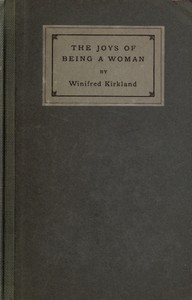
Before opening The Joys of Being a Woman, and Other Papers — A Closer Reading, the edition data offers a quick orientation: 64,464 words, 4 hr 41 min estimated reading time, and 6 detected text sections.
The text analysis averages about 25.0 words per sentence, while the detected sections provide another way to judge how the source is divided.
Project Gutenberg metadata also associates the work with “Women,” connecting these edition facts with the source record’s subject description.
Explore this collection
These alternatives are selected using recorded categories and estimated reading time.
About 297 minutes
Science Fiction Utopias
68,157 recorded words. 16 minutes difference from this book's estimate.
View Gutenberg source #8571About 263 minutes
Science Fiction Utopias
60,345 recorded words. 18 minutes difference from this book's estimate.
View Gutenberg source #53538About 300 minutes
Science Fiction Utopias
68,784 recorded words. 19 minutes difference from this book's estimate.
View Gutenberg source #1915Search stored excerpts and compare books → Choose by your preferences →
Choices use stored catalog measurements. Estimates vary with reading speed. A shared category is a catalog label, not a claim that two books have the same argument or literary quality.
Search reads excerpt text stored with this catalog and links to its associated Gutenberg record. The connection is stored in the site database; this tool does not recheck that every excerpt is word-for-word identical to that external record. Excerpt search does not cover every chapter and does not verify historical publication dates.
Catalog snapshot checked: 2026-09-25. Coverage: 96 public books, 96 available source excerpts.
Read the complete public-domain text at its original source.
Read on Project GutenbergWinifred Kirkland opens her collection with a foreword that defines the essay as a flexible garment for the elusive self, a form that captures personality better than poetry. She invokes Charles Lamb as the master of this art, praising his ability to invest his own ego with grace. Kirkland's own voice emerges as both playful and precise, warning that the essay is no easy thing—it requires a childlike ability to hear one's inner self speak in joy. This tension between artlessness and craft sets the stage for a series of papers that examine writing, womanhood, and the demands of daily life.
Kirkland's foreword establishes a central paradox: the essay appears artless, like a little boat sailing without chart or compass, yet it demands rare skill. She argues that only those who can hear their own fairy comrade—the true Self—can write essays that warm readers with friendship. This self speaks only in joy, and following it requires childlike feet. Kirkland contrasts this ideal with the reality of readers who hound authors for autobiography, tearing books to shreds to find recognizable portraits. She insists that a writer's head contains a thousand unseen faces, all begging for story, and that the relation between experience and expression is deep and intricate, not a mere introduction of facts.
In a later excerpt, Kirkland recounts how friends and family constantly assume her fiction is drawn from their lives. They beam and say, 'Oh, here is Aunt Sarah's chicken-pen!' when the scene describes a well in Brittany. They claim to recognize characters from a single meeting years ago. Kirkland finds this impulse universal: readers are unwilling to let an author possess an imagination. She notes that even critics, when authors are famous enough to be dead, rake the ground to prove that fictional folk were drawn from earth rather than air. This pressure to be autobiographic, she implies, is especially acute for women writers, who must adjust their work to a feminine body, brain, and social relations.
Kirkland also addresses the romantic notion of pure inspiration. She observes that nine-tenths of people want to write, seven-tenths have tried, and only one-tenth understand why they failed. Many think the impulse is more distinctive than its accomplishment, and they regard a writer who goes to her desk every morning like a machine with half-contemptuous envy. Kirkland bluntly states her conviction that any person who could have written would have written, and that her only introduction to editors was made by her own manuscripts. She dismisses the idea of a charmed approach, emphasizing that creation is not merely inspirational but requires steady work.
Kirkland's essays resist easy categorization; they are neither pure memoir nor detached criticism. Readers will find her observations on the writer's life both specific and resonant, particularly her insistence on the reality of the imagination against the demands of literal-minded readers. The collection rewards those who attend to her shifts between humor and seriousness, and who appreciate the craft behind her seemingly artless prose.
There are evenings when Kirkland’s essay about the stubborn discipline behind a sentence reminds me of sitting by a lamplit window, pages rustling like distant footfalls. Her fierce, practical honesty felt softer then, a quieter companion. I found an echo of that quiet in Philosophic Nights in Paris Being selections from Promenades Philosophiques — Background and Themes, where thought itself hesitates, lovely and unhurried, asking only for patience.
Use these questions to collect your thoughts before moving on.