About 571 minutes
Letters of Felix Mendelssohn-Bartholdy from 1833 to 1847 — Key Ideas to Explore
Fantasy Juvenile Worlds
131,308 recorded words. 106 minutes difference from this book's estimate.
View Gutenberg source #50473
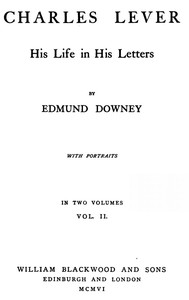
The source record for Charles Lever, His Life in His Letters, Vol. II — Edition Insights measures this digital text at 106,889 words, 7 hr 45 min estimated reading time, and 12 detected text sections.
The text analysis averages about 20.2 words per sentence, while the detected sections provide another way to judge how the source is divided.
Project Gutenberg metadata also associates the work with “Lever, Charles James, 1806-1872 -- Correspondence,” connecting these edition facts with the source record’s subject description.
Explore this collection
These alternatives are selected using recorded categories and estimated reading time.
About 571 minutes
Fantasy Juvenile Worlds
131,308 recorded words. 106 minutes difference from this book's estimate.
View Gutenberg source #50473About 317 minutes
Fantasy Juvenile Worlds
72,787 recorded words. 148 minutes difference from this book's estimate.
View Gutenberg source #72510About 297 minutes
Fantasy Juvenile Worlds
68,230 recorded words. 168 minutes difference from this book's estimate.
View Gutenberg source #13441Search stored excerpts and compare books → Choose by your preferences →
Choices use stored catalog measurements. Estimates vary with reading speed. A shared category is a catalog label, not a claim that two books have the same argument or literary quality.
Search reads excerpt text stored with this catalog and links to its associated Gutenberg record. The connection is stored in the site database; this tool does not recheck that every excerpt is word-for-word identical to that external record. Excerpt search does not cover every chapter and does not verify historical publication dates.
Catalog snapshot checked: 2026-09-25. Coverage: 96 public books, 96 available source excerpts.
Read the complete public-domain text at its original source.
Read on Project GutenbergThe letters in this volume, spanning 1864 to 1872, trace Charles Lever's movements from Florence and Spezzia to Trieste, with each location shaping the tone of his correspondence. The opening letter, dated January 2, 1864, from Casa Capponi, immediately establishes the collaborative relationship with his publisher John Blackwood: Lever refers to the serialized story 'Tony' and acknowledges Blackwood's influence on its development. The letters are not merely personal; they are working documents, filled with negotiations over instalments, proofs, and revisions. Lever's voice is direct and often self-deprecating, as when he describes his epitaph: 'For fifty odd years I lived in the thick of it, / And now I lie here heartily sick of it.' The structure of the volume follows a chronological sequence, but the real movement is between Lever's literary ambitions and his physical decline.
Edmund Downey's editorial presence is minimal but strategic. He provides brief footnotes, such as identifying Sidney Lever as the author of 'Fireflies,' and occasionally clarifies references. The letters themselves, however, are the primary text, and they reveal a writer deeply engaged in the mechanics of serial publication. Lever frequently sends instalments of his stories—'Tony,' 'O'Dowd,' and others—and asks for Blackwood's counsel. In one letter, he writes, 'I am not sure—so much has your criticism on “Tony” weighed with me, and so far have I welded his fortunes by your counsel—that you’ll not have to own it one of these days as your own.' This collaborative dynamic is central to understanding Lever's creative process. The letters also show his responsiveness to reader and critic feedback, as when he revises a squib about 'M'Caskey' after Blackwood's reservations. The serial format demanded quick adjustments, and Lever's letters capture that pressure.
Throughout the volume, Lever's physical condition is a recurring undercurrent. He mentions 'the ague' in 1864, and by 1868 he describes attending the ex-Emperor's funeral in Trieste: 'four mortal hours in a uniform on a mule, with a fierce north-easter and a High Mass!' The humour is characteristic—Lever often deflects discomfort with wit. Yet the letters also reveal a man aware of his own decline. He writes of Thackeray's death with genuine sorrow, recalling their evenings at Templeogue, and reflects on the fate of writers who 'go on pouring water on the lees.' The epitaph he composes for himself is a dark joke, but it underscores a preoccupation with legacy. The movement between lighthearted anecdotes and somber reflections gives the correspondence a layered emotional texture.
Lever's letters frequently engage with contemporary politics, particularly the Irish Church debate. In February 1868, he writes, 'The Irish Church is doomed. The only question is not who is to use the crowbar, but how to get out of the way when the edifice is falling.' This blunt assessment is typical of his style: he avoids sentimentality and favors sharp, almost cynical observation. He also discusses a squib he wrote, 'M'Caskey,' which he insists is 'sarcasm, not seriousness.' The letters show him navigating the expectations of his publisher, who worried the piece might be misread. Lever's political commentary is woven into his literary work, and the correspondence reveals how he calibrated his tone for different audiences. His refusal to lecture in America, citing the 'Irish element that would certainly assail me,' further illustrates his awareness of his public persona.
Beyond literary business, the letters offer glimpses of Lever's domestic world. He mentions his youngest daughter's review of a book and her account of Maximilian's funeral published in 'The Times,' expressing a wish to see her work in 'Maga.' These details humanize the writer, showing pride in his children's accomplishments. He also references friends like Lytton and Bowes, and his correspondence with Blackwood includes warm personal regards: 'Give my warmest and best regards to your wife.' The letters from Trieste, where Lever settled, convey a sense of isolation tempered by routine. He envies Blackwood's London life but admits he would not want to live there permanently. The recurring image of the mule ride at the funeral—absurd and uncomfortable—epitomizes Lever's ability to find humor in the mundane.
Readers approaching this volume should attend to the interplay between Lever's literary output and his personal circumstances. The letters are not a polished autobiography but a raw record of a working writer's life. Pay attention to the shifts in tone—from playful to weary—and the recurring motifs of health, politics, and collaboration. The editorial notes are sparse, so the letters themselves must carry the narrative. This is a document of process, not product, and its value lies in the immediacy of Lever's voice.
Reading Lever’s letters, I remembered sitting on my grandmother’s porch, her old copy of Cobb's Bill-of-Fare — Themes and Context open in my lap. The way he grumbles about editors while loving the work—that same stubborn affection ran through Cobb’s menu of daily woes. Both felt like eavesdropping on a friend who’d rather complain than stop.
A brief reflection can help important ideas stay with you longer.