About 633 minutes
The Letters of Charles Dickens. Vol. 1, 1833-1856 — Story, Setting & Ideas
Fantasy Juvenile Worlds
145,388 recorded words. 62 minutes difference from this book's estimate.
View Gutenberg source #25852
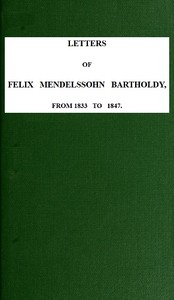
The catalog record for Letters of Felix Mendelssohn-Bartholdy from 1833 to 1847 — Key Ideas to Explore provides practical reading context through 131,308 words, 9 hr 31 min estimated reading time, and 15 detected text sections.
The text analysis averages about 22.9 words per sentence, while the detected sections provide another way to judge how the source is divided.
Project Gutenberg metadata also associates the work with “Mendelssohn-Bartholdy, Felix, 1809-1847 -- Correspondence,” connecting these edition facts with the source record’s subject description.
Explore this collection
These alternatives are selected using recorded categories and estimated reading time.
About 633 minutes
Fantasy Juvenile Worlds
145,388 recorded words. 62 minutes difference from this book's estimate.
View Gutenberg source #25852About 465 minutes
Fantasy Juvenile Worlds
106,889 recorded words. 106 minutes difference from this book's estimate.
View Gutenberg source #35865About 682 minutes
Fantasy Juvenile Worlds
156,730 recorded words. 111 minutes difference from this book's estimate.
View Gutenberg source #43222Search stored excerpts and compare books → Choose by your preferences →
Choices use stored catalog measurements. Estimates vary with reading speed. A shared category is a catalog label, not a claim that two books have the same argument or literary quality.
Search reads excerpt text stored with this catalog and links to its associated Gutenberg record. The connection is stored in the site database; this tool does not recheck that every excerpt is word-for-word identical to that external record. Excerpt search does not cover every chapter and does not verify historical publication dates.
Catalog snapshot checked: 2026-09-25. Coverage: 96 public books, 96 available source excerpts.
Read the complete public-domain text at its original source.
Read on Project GutenbergMendelssohn’s letters from 1833 to 1847 offer a direct view of his working mind, often in unguarded moments. In a letter to Franz Hauser, he dismisses the Berlin Conservatorium project as too remote to discuss with certainty, adding that while he is personally well received, “it is proportionably difficult to aid the cause.” This tension between personal gratitude and institutional frustration recurs throughout the volume. The letters are not polished memoirs but hurried dispatches—sometimes self-critical, as when Mendelssohn calls one of his own letters “hypochondriacal” and promises a “more rose-coloured aspect” next time. Such remarks reveal a writer aware of his shifting moods and willing to expose them to his correspondents.
Mendelssohn’s vocabulary often registers disappointment with precision. Describing a performance by the singer Pasta, he notes that audiences “unjustly praised her to the skies” after deliberate reflection, calling this “a bad kind of delight.” The phrase is characteristic: he distrusts praise that is not spontaneous. Elsewhere, he complains of “shameless flatterers, or equally shameless critics,” both of which “deprive us of all pleasure.” His diction tends toward moral judgment—words like “unjustly,” “shameless,” and “bad” recur—suggesting that for Mendelssohn, aesthetic response was inseparable from ethical evaluation. He does not merely dislike poor taste; he finds it culpable.
The letters concerning his Berlin appointment show a careful, almost legalistic tone. Mendelssohn writes that he “came to this conclusion, on seeing the proceedings more closely,” and that “years may pass away, nothing may ever come of it.” He avoids direct complaint, instead framing his observations as conclusions drawn from evidence. Yet his frustration surfaces in the passive construction: “it is said the desire for it exists.” The editor’s preface notes that these negotiations “take up a large space” and are “characteristic of the manner in which he conceived and conducted such matters.” The letters reveal a man who navigates institutional politics with guarded optimism, always measuring his words.
When Mendelssohn writes about a project that excites him, his syntax shifts. In the letter to Ferdinand David about Antigone, he uses short, breathless clauses: “I got hold of old Tieck, and said ‘Now or never!’ and he was amiable, and said ‘Now!’ and so I composed music for it to my heart’s content.” The repeated “and” creates a cumulative rhythm, mirroring the momentum of the collaboration. He contrasts this with the skepticism of Berlin, where “all in Berlin of course think that we are very sly.” The sentence structure itself enacts the difference between genuine artistic impulse and the cynical interpretations of others. Mendelssohn’s enthusiasm is syntactically distinct from his disappointment.
Several letters include moments where Mendelssohn interrupts himself to adjust his tone. After a long complaint about the Pasta performance, he writes: “How hypochondriacal this letter is become! I ought rather to write to you in a gayer strain, to cheer you. Next time I shall try to find a more rose-coloured aspect; forgive the dark-brown hues of to-day.” This self-awareness is not mere politeness; it reflects a deliberate rhetorical strategy. He treats his letters as performances that can be revised in the next installment. The metaphor of color—“dark-brown hues”—suggests he conceives of mood as something applied, like paint. Such passages give the collection an intimate, dialogic quality, as if Mendelssohn is speaking to himself as much as to his correspondent.
Readers approaching these letters should expect a voice that is by turns impatient, self-mocking, and fiercely principled. Mendelssohn rarely writes at length about his compositions; instead, he writes about the conditions under which music is made—audiences, institutions, collaborators. The letters are best read as a record of how a composer navigated the social world of nineteenth-century music, with all its flattery, delay, and occasional moments of genuine collaboration. The editorial selection, made by his brother and son, emphasizes professional over domestic life, but the personality that emerges is unmistakably individual.
Reading these letters, I remembered sitting alone during a rainy afternoon, tracing how Mendelssohn’s frustrations with audiences echoed my own quiet doubts about whether anyone truly listens. Thirty Letters on Various Subjects, Vol. 1 (of 2) — Reading Notes once gave me that same intimate feeling—like overhearing a friend think aloud, without needing to answer.
Capture what you thought, learned, and would like to remember.