About 163 minutes
The Treasure of the Humble — Reading Notes
Historical Psychological Social Fiction
37,343 recorded words. 35 minutes difference from this book's estimate.
View Gutenberg source #48217
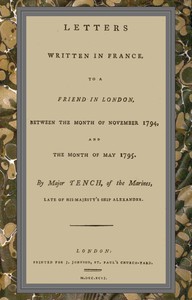
The catalog record for Letters written in France, to a friend in London, between the month of November 1794, and the month of May 1795 — Text and Context provides practical reading context through 45,447 words, 3 hr 18 min estimated reading time, and 5 detected text sections.
The text analysis averages about 30.1 words per sentence, while the detected sections provide another way to judge how the source is divided.
Project Gutenberg metadata also associates the work with “Tench, Watkin, 1759?-1833 -- Correspondence,” connecting these edition facts with the source record’s subject description.
Explore this collection
These alternatives are selected using recorded categories and estimated reading time.
About 163 minutes
Historical Psychological Social Fiction
37,343 recorded words. 35 minutes difference from this book's estimate.
View Gutenberg source #48217About 249 minutes
Historical Psychological Social Fiction
57,217 recorded words. 51 minutes difference from this book's estimate.
View Gutenberg source #3140About 265 minutes
Historical Psychological Social Fiction
60,927 recorded words. 67 minutes difference from this book's estimate.
View Gutenberg source #53467Search stored excerpts and compare books → Choose by your preferences →
Choices use stored catalog measurements. Estimates vary with reading speed. A shared category is a catalog label, not a claim that two books have the same argument or literary quality.
Search reads excerpt text stored with this catalog and links to its associated Gutenberg record. The connection is stored in the site database; this tool does not recheck that every excerpt is word-for-word identical to that external record. Excerpt search does not cover every chapter and does not verify historical publication dates.
Catalog snapshot checked: 2026-09-25. Coverage: 96 public books, 96 available source excerpts.
Read the complete public-domain text at its original source.
Read on Project GutenbergWatkin Tench, a British marine officer captured at sea in November 1794, writes from the French port of Brest and its environs to a friend in London. His letters move between the cramped quarters of a prison ship and the streets of a provincial town, recording what he calls the 'skirting of France'—a region remote from the usual traveller's route. Tench's eye for physical detail is precise: he notes the thickness of stone walls, the absence of ceilings in most houses, and the gaping chasms between floorboards. Yet his account is not merely descriptive; it is shaped by the revolutionary upheaval that has remade the landscape around him.
Tench devotes considerable attention to the domestic architecture of the town, observing that of perhaps 1,500 houses, fewer than fifty have a single ceiled room, and scarcely ten have all their apartments ceiled. The floors are equally unsightly, with 'gaping chasms of the planks' and a general state of dirt. Yet alongside this neglect, he finds surprising luxury: vast mirrors, beautiful plate glass, and fine French engravings—though the latter have been defaced by the clumsy erasure of dedications to princes and marshals. The democratic 'lust of destruction' after August 1792 ordered all heraldic emblems removed from houses and furniture alike, even from snuff-boxes and seals. Tench now eats with spoons from which family marks have been carefully expunged, a detail that leads him to inquire further into the erasure of aristocratic identity.
One of the most striking transformations Tench records is the conversion of churches into state workshops. The cathedral retains its majestic exterior, but over its principal door is inscribed 'Le peuple Français reconnait l’Etre Suprème.' Other churches and monasteries have become hospitals, stables, magazines, or manufactories of saltpetre. Tench visits one such church with an English gentleman and is allowed to inspect the entire process. Against one wall are piled heaps of wood-ashes; nearby, casks with perforated bottoms are filled with the ashes, through which water drains to form a vegetable alkaline lixivium. The opposite side of the church is filled with ruins of old houses and heaps of earth from stables, slaughter-houses, and cemeteries—'full of the wrecks of humanity.' These materials are macerated and evaporated to produce saltpetre for gunpowder, a grim repurposing of sacred space for revolutionary warfare.
Tench notes that formerly there were two public walks on the banks of the river, but the 'stately elms' that formed one of them have been cut down, to the great dissatisfaction of the inhabitants, and sent to Brest for keels of ships. This small detail encapsulates a larger pattern: the revolutionary state's demand for military matériel overriding local amenities and traditions. Tench does not dwell on the loss, but his matter-of-fact reportage underscores the material sacrifices imposed by war. The felled elms, like the converted churches, are part of a landscape being reshaped by conflict, where even trees are conscripted into the service of the Republic.
Throughout the letters, Tench resists drawing broad conclusions, acknowledging that a man who has seen only this 'skirting of France' would demonstrate 'the highest degree of presumption' were he to pretend to draw a parallel between it and England. Nevertheless, he ventures to affirm that civilization, luxury, and a general diffusion of the comforts of life are more advanced in Cornwall and Wales than in this province, even before the revolution. This comparative judgment is carefully hedged, but it reveals Tench's underlying framework: he measures French provincial life against a British baseline, finding it lacking in domestic comfort and material well-being. His observations on unfinished interiors, erased heraldry, and repurposed churches all feed into this assessment, grounding his critique in tangible, everyday details rather than abstract political theory.
Tench's letters offer a ground-level view of revolutionary France as seen by a captive with a sharp eye for material culture. Readers should attend to the way he moves between the intimate scale of a spoon with its marks erased and the public scale of a cathedral turned saltpetre factory. His account is not a comprehensive history but a series of precise, situated observations that reveal how revolution remakes even the most ordinary objects and spaces.
Some letters just stay with you, don’t they? Tench’s quiet watching—how ordinary rooms held the weight of what disappeared—reminded me of another collection, where private confidences echo the same ache of change. I kept thinking about that after closing both. Letters to Severall Persons of Honour — Themes and Context feels like a slow exhale beside it, not loud, just present.
Create a short personal record of your experience with this book.