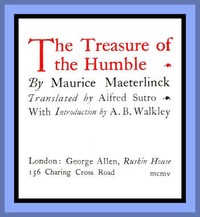
Maurice Maeterlinck, known primarily as a dramatist, here turns philosopher and aesthetician, as A. B. Walkley notes in his introduction. The essays in The Treasure of the Humble examine the invisible forces that shape human existence—silence, the soul, and the tragic in everyday life. Walkley warns that Maeterlinck appeals to the elect, quoting Plotinus: if you do not feel the charm of beauty, it is vain to seek it. This sets the tone for a work that demands a certain disposition from its reader.
The excerpts reveal a writer who blends mysticism with literary criticism, analyzing Ibsen's The Master Builder to illustrate how inner and outer dialogue can be fused. Maeterlinck's prose is dense with metaphor, and his ideas often circle back to the limits of reason and the primacy of intuitive knowledge.
Silence as a Language
In the essay on silence, Maeterlinck argues that true communication occurs not through words but through the silences that surround them. He writes that when we speak of trivial matters, something deeper nods between us. This idea is central to his view of human relationships: we know others not by their actions or speech but by a mysterious moment when we perceive their relationship to the unknown. The excerpts show how he applies this to friendship, claiming that after a certain point, we see the attitude destiny has taken toward a person. This is not a claim about plot but about a mode of perception that Maeterlinck insists is available to even the most unintelligent.
The Tragic in the Ordinary
Maeterlinck's concept of the tragic is not about grand events but the quiet, everyday moments that reveal deeper truths. He praises Ibsen's The Master Builder for blending inner and outer dialogue, creating a 'somnambulistic drama' where a new, indescribable power dominates. The excerpts suggest that Maeterlinck values literature that hints at an unknown life beneath the surface. He warns that our soul often appears to our feeble eyes as the maddest of forces, and that there are regions more fertile than reason. This section of the book challenges readers to look beyond plot and character to the invisible currents that shape them.
Destiny and the Poet's Torch
In 'The Star,' Maeterlinck traces how tragic poets have wandered through the labyrinths of destiny with the torch of poesy. He argues that the purest essence of a nation's soul is found in the poets' idea of power. The excerpts note that the most beautiful period of mankind was when destiny seemed most terrible—the happiest people worshipped an incomprehensible divinity. This historical observation is not a claim about specific events but a reflection on how human happiness and fear of the unknown are intertwined. Maeterlinck's language here is sweeping, but he grounds it in the idea that the poet fixes the souls of annals, making divine history.
Reading Between the Lines
The excerpts from The Treasure of the Humble are incomplete, but they reveal a consistent method: Maeterlinck uses literary examples to illustrate philosophical points, often drawing on Ibsen and Plotinus. His style is aphoristic and recursive, circling back to the same themes of silence, destiny, and inner life. Readers should pay attention to how he moves from concrete observations—such as the way we know a friend's fate—to abstract claims about the soul. The translation by Alfred Sutro preserves a formal, slightly archaic tone that suits the mystical content. The introduction by Walkley provides context, but the essays themselves are best approached as meditations rather than arguments.
The Treasure of the Humble rewards a patient, reflective reading. Maeterlinck does not offer easy conclusions but instead invites readers to consider the silences between words and the forces that shape our lives without our knowledge. The essays are interconnected, each building on the idea that there is more to existence than reason can grasp. For those willing to follow his expedition to the borderland of human thought, the book offers a distinctive vision of the tragic and the mystical in everyday life.
Reading Maeterlinck’s quiet insistence on the unspoken, I found myself thinking of how often the truest words are the ones we scribble in haste. His essays dwell on the soul’s hidden dialogue, yet there’s a strange echo in those hurried, intimate lines from a soldier to his wife—Napoleon's Letters to Josephine, 1796-1812 For the First Time Collected and Translated, with Notes Social, Historical, and Chronological, from Contemporary Sources — Background and Themes—where silence between battles speaks louder than any proclamation. Both felt like fragments of a longer, unfinished conversation.