About 54 minutes
Religio Journalistici — Key Ideas to Explore
Fantasy Juvenile Worlds
12,206 recorded words. 19 minutes difference from this book's estimate.
View Gutenberg source #66145
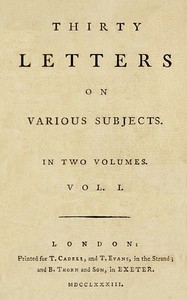
Thirty Letters on Various Subjects, Vol. 1 (of 2) — Reading Notes can be approached with a clearer sense of reading commitment from its source measurements: 16,623 words, 1 hr 13 min estimated reading time, and 21 detected text sections.
The text analysis averages about 24.0 words per sentence, while the detected sections provide another way to judge how the source is divided.
Project Gutenberg metadata also associates the work with “Poets, English -- 18th century -- Correspondence,” connecting these edition facts with the source record’s subject description.
Explore this collection
These alternatives are selected using recorded categories and estimated reading time.
About 54 minutes
Fantasy Juvenile Worlds
12,206 recorded words. 19 minutes difference from this book's estimate.
View Gutenberg source #66145About 92 minutes
Fantasy Juvenile Worlds
21,112 recorded words. 19 minutes difference from this book's estimate.
View Gutenberg source #76201About 51 minutes
Fantasy Juvenile Worlds
11,714 recorded words. 22 minutes difference from this book's estimate.
View Gutenberg source #11990Search stored excerpts and compare books → Choose by your preferences →
Choices use stored catalog measurements. Estimates vary with reading speed. A shared category is a catalog label, not a claim that two books have the same argument or literary quality.
Search reads excerpt text stored with this catalog and links to its associated Gutenberg record. The connection is stored in the site database; this tool does not recheck that every excerpt is word-for-word identical to that external record. Excerpt search does not cover every chapter and does not verify historical publication dates.
Catalog snapshot checked: 2026-09-25. Coverage: 96 public books, 96 available source excerpts.
Read the complete public-domain text at its original source.
Read on Project GutenbergWilliam Jackson opens his first letter by declaring a wish to strike "out of the beaten track," a phrase that sets the tone for the entire volume. The letters are not personal correspondence but crafted essays on topics ranging from the force of custom to musical catches, painting, and the English language. Jackson adopts the persona of a retired observer whose retirement "will naturally give an air of peculiarity to my sentiments." This framing allows him to critique contemporary taste and intellectual habits with a blend of irony and directness, as when he notes that custom, "unassisted by truth, has worked the greatest miracles." The epistolary form is a deliberate choice: the advertisement admits that whether these are real letters is "a point of no great consequence," and that the physic matters more than the form.
Jackson's first letter establishes custom as his primary antagonist. He argues that custom can sanctify "nonsense in all the arts, sciences, and even religion itself." The phrasing is deliberately provocative, and he urges his correspondent to "divest yourself of the partiality acquired by habit." This is not a neutral observation; Jackson is setting up a method of skeptical inquiry that runs through the collection. He does not claim that all custom is bad, but that its force is so great it can make falsehood seem true. The letter on "The Force of Custom" thus serves as a methodological preface, warning readers that many received doctrines will be attacked. Jackson's diction is precise: he speaks of "prejudice" and "partiality" as obstacles to clear judgment, and he positions himself as a solitary truth-teller whose retirement gives him a clearer view.
Letter X, "On Catches," is one of the most vivid in the volume. Jackson describes the catch as a musical form that "in a manner owed its existence to a drunken club." He paints a scene of "savage folly" where singers depart from pitch, speak different words simultaneously, and compete to outsing each other. The language is deliberately harsh: he calls it a "scene of savage folly" that would not disgrace "the Hottentots." Yet Jackson is not merely condemning; he notes that catches flourished in the reign of George III despite the age's refinement. He accuses modern composers of producing imitations of ancient catches that "betray itself, within three bars, to be modern." The digression on Rowley's Poems shows his wider concern with authenticity and anachronism. He ends the letter with a wry postscript, acknowledging that his correspondent may like catches and inviting revenge.
Jackson frequently draws parallels between different arts. In Letter XVII, "On the Analogy of the Arts," he argues that painting, music, and poetry share underlying principles. This is not a systematic treatise but a series of observations grounded in specific examples. He compares the use of parentheses in writing to certain musical effects, and he criticizes "temporary taste" that elevates fashion over substance. His method is associative rather than deductive; he moves from a remark about Corelli and Handel to a comment on modern performers who are "more elegant, tho' less solid." The analogy serves to reinforce his central claim that judgment should be based on intrinsic qualities, not on custom or novelty. Jackson's voice remains conversational, but his references to specific composers and painters show a well-informed mind.
The letters are addressed to an unnamed correspondent, and Jackson uses this relationship to create a sense of intimacy and directness. He often anticipates objections, as when he writes, "Forgive me this digression, but indeed I have nearly finished my subject and letter." The persona is that of a retired gentleman who is both learned and slightly eccentric. He claims to "pretend to no more delicacy than that of the age I live in," yet he is clearly more refined than the catch-singers he condemns. The advertisement's playful dismissal of the letters' authenticity—"the invention of a story to shew how they came into the editor's hands is by no means difficult"—adds a layer of irony. Jackson is aware that his observations may be taken as peculiar, but he insists that if "the physic be wholesome, it is no matter under what form it is administered."
Jackson's letters reward readers who enjoy pointed, opinionated criticism grounded in specific examples. The volume is best approached as a series of essays rather than a unified argument; each letter stands on its own, and the connections between them are thematic rather than linear. Readers interested in eighteenth-century debates about taste, the relationship between the arts, or the social history of music will find Jackson a lively and often surprising commentator. His voice is distinctive—at once urbane and blunt, learned and skeptical—and his willingness to attack sacred cows makes the collection as entertaining as it is instructive.
Reading Jackson’s Thirty Letters, I felt his quiet insistence on trusting one’s own impressions over learned chatter. It reminded me, oddly, of a different solitude—the unhurried patience of someone waiting by a stream. That same gentle defiance of noise lives in Hunting Sketches — Context and Discussion, where observation asks for nothing but its own company.
Create a short personal record of your experience with this book.