About 97 minutes
Hunting Sketches — Context and Discussion
Fantasy Juvenile Worlds
22,199 recorded words. 5 minutes difference from this book's estimate.
View Gutenberg source #814
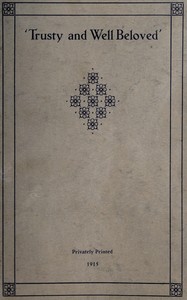
For 'Trusty and well beloved' — Themes and Context, the stored edition analysis reports 21,112 words, 1 hr 32 min estimated reading time, and 5 detected text sections.
The text analysis averages about 21.8 words per sentence, while the detected sections provide another way to judge how the source is divided.
Project Gutenberg metadata also associates the work with “World War, 1914-1918 -- Personal narratives,” connecting these edition facts with the source record’s subject description.
Explore this collection
These alternatives are selected using recorded categories and estimated reading time.
About 97 minutes
Fantasy Juvenile Worlds
22,199 recorded words. 5 minutes difference from this book's estimate.
View Gutenberg source #814About 99 minutes
Fantasy Juvenile Worlds
22,605 recorded words. 7 minutes difference from this book's estimate.
View Gutenberg source #24595About 73 minutes
Fantasy Juvenile Worlds
16,623 recorded words. 19 minutes difference from this book's estimate.
View Gutenberg source #59710Search stored excerpts and compare books → Choose by your preferences →
Choices use stored catalog measurements. Estimates vary with reading speed. A shared category is a catalog label, not a claim that two books have the same argument or literary quality.
Search reads excerpt text stored with this catalog and links to its associated Gutenberg record. The connection is stored in the site database; this tool does not recheck that every excerpt is word-for-word identical to that external record. Excerpt search does not cover every chapter and does not verify historical publication dates.
Catalog snapshot checked: 2026-09-25. Coverage: 96 public books, 96 available source excerpts.
Read the complete public-domain text at its original source.
Read on Project GutenbergThis record is a father's compilation of his son's letters and diary entries, preserving the voice of Second Lieutenant Arthur Oscar Hornung of the 3rd (attached 2nd) Essex Regiment. The narrative shifts from the buoyant enthusiasm of a public-school boy eager to 'have a plug at those blighters over the water' to the terse, matter-of-fact accounts of trench life. The opening pages describe his departure on an April morning 'as sunny as his smile,' a tone that gradually gives way to the weary rhythms of 'slopping up and down our own little section of trench.' The father's framing is minimal, letting Oscar's own words carry the story.
The earliest letters are marked by a schoolboy's relish for adventure. Oscar writes of the Seine as 'a river of roses,' of French villagers cheering, and of his men singing 'Tipperary.' He describes censoring letters as 'rather fun' and details sprees and sight-seeings in Rouen. The language is buoyant, full of exclamation marks and phrases like 'it is glorious.' Yet within weeks, the tone shifts. By June, he writes of 'another quiet day' and notes that 'sleep is apt to be disturbed so rudely at all hrs. of the day!' The excitement of departure has been replaced by the monotony of trench routine, punctuated by sudden violence.
One of the most vivid passages describes a night raid Oscar planned and led. He compares the hand-bombs to cricket balls—'just the size and weight of a Cricket Ball!'—and recounts 'throwing in' from 'cover' as if on the playing fields of Eton. The language is precise: he notes the distance (200 yards), the formation (single file), and the use of flares to gauge position. Yet the sporting metaphor clashes with the reality: 'we could distinctly hear Fritz breathing hard over his spade-work.' The raid is described as a 'scrap,' but the aftermath—a 'slight wound' under the ear—is treated with understatement. This section reveals how Oscar's public-school vocabulary frames his experience of war.
The father, E. W. Hornung, provides only brief connective tissue, such as 'At any rate Oscar enjoyed himself' or 'But all his life it took a great deal to weary Oscar.' These interventions are sparse, allowing Oscar's letters to dominate. The editorial hand is most visible in the selection and ordering of material, but the father rarely interprets or eulogizes. The result is a record that feels immediate and unmediated, though it is clearly shaped by a parent's desire to memorialize. The reader is left to infer the trajectory from the letters themselves, without explicit commentary on the growing weight of experience.
Readers should attend to the shifts in register—from the jaunty slang of 'some boys' to the quiet admission that 'we're none the worse for living like this.' The letters do not offer a complete arc; they break off mid-sentence. The father's restraint means that the silences between entries carry as much weight as the words. This is not a polished memoir but a collection of fragments, and its power lies in what is left unsaid.
This morning I thought of my father’s quiet study, the way he’d close a volume with a sigh. Letters from a lost son, like Hornung’s, hold that same hollow ache. It reminded me of leafing through Charles Lever’s correspondence years ago, a similar feeling of a life caught between ink and silence. Charles Lever, His Life in His Letters, Vol. II — Edition Insights has that weight, too, full of unguarded moments that time has made precious.
Use these questions to collect your thoughts before moving on.